Money20/20 Bangkok: The Convergence of Web3 and TradFi is Here
Money20/20 Bangkok Reaffirmed What We Already Knew: The Convergence Is Here
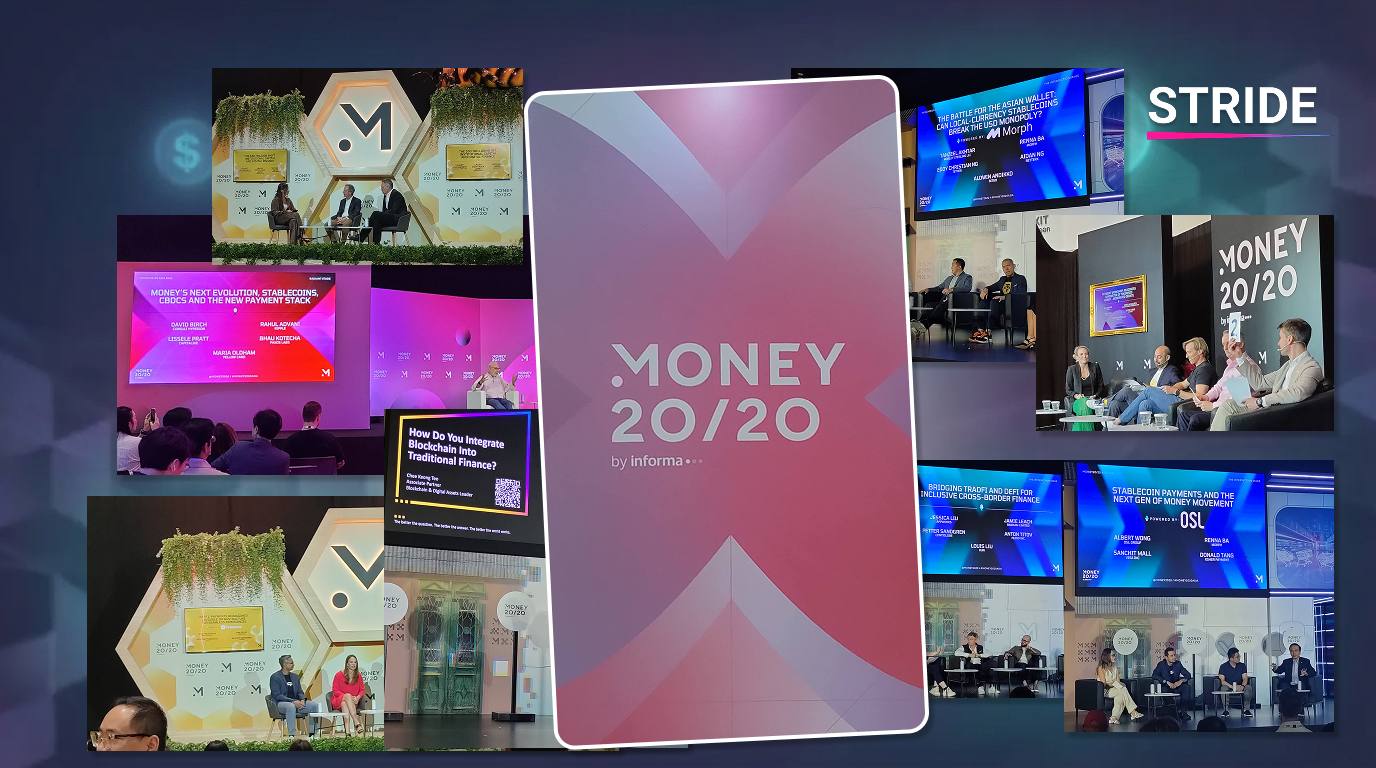
STRIDE was at Money20/20 Asia in Bangkok last week, and the three days we spent there reaffirmed our thesis: the next biggest opportunity in financial services is the convergence of Web3 and traditional finance.
This wasn't a fringe opinion at the event. It was the main event. Money20/20 literally built a dedicated stage for it, called "The Intersection Stage," where leaders from major banks, digital asset firms, and regulators gathered to work through what this convergence actually looks like in practice.
Here's what stood out to us.
The debate is over. The work has begun.
The "TradFi vs. Web3" framing has run its course. Nobody in Bangkok was arguing about whether banks should engage with stablecoins, tokenized assets, or digital payment rails. The conversation has moved to implementation: how do you bring these capabilities into a regulated banking environment without breaking what already works?
That shift in tone was reflected across the entire agenda, from sessions on tokenized asset markets and stablecoin payment rails to panels featuring executives from Standard Chartered, Kasikorn Bank, and Paxos discussing real deployments, not hypotheticals.
Banks want compliance-first, not compliance-later
A recurring theme across every banking-focused session: compliance can't be an afterthought. Commercial banks aren't interested in bolting regulatory controls onto crypto-native infrastructure after the fact. They need compliance baked into the architecture from day one.
This aligns directly with how STRIDE OS is built. Dual-Rail Banking puts compliance at the center of the stack, not at the edges.
Invisible to users, transparent to regulators
One of the clearest points of agreement in Bangkok: end-users shouldn't need to know which rail their transaction is running on. Whether it's fiat or tokenized, the experience should be identical.
But regulators need full visibility. They need to see exactly what's happening, on which rail, under which framework.
That duality, invisible to one audience and transparent to another, is a design challenge that most infrastructure providers haven't solved. It's a core principle of STRIDE OS.
Modular beats monolithic
Banks aren't looking to rip out their core systems. They're looking for modular solutions they can plug into what they already run. The appetite for monolithic platform replacements is effectively zero.
This is why STRIDE OS is designed as an orchestration layer. It sits alongside existing banking infrastructure and enables banks to operate fiat and tokenized rails in parallel, without replacing anything.
Regulation is moving, but every jurisdiction is moving differently
Stablecoin regulation is accelerating globally. The GENIUS Act in the US, MiCA in Europe, Hong Kong's Stablecoin Ordinance, Singapore's MAS DTSP regime, Japan's push for banking participation in digital assets. The direction is clear.
But the specifics vary significantly from one jurisdiction to the next. Banks operating across borders need infrastructure that can adapt to each regulatory environment, not a one-size-fits-all approach.
Over 80 regulatory bodies attended Money20/20 this year, not as observers but as active participants in working sessions alongside the private sector. That's a meaningful signal. Regulators are co-building the frameworks, not just enforcing them.
The missing layer is orchestration
If there was one gap the Bangkok conversations kept circling back to, it was this: the industry has the rails. It has the regulatory momentum. What it doesn't have is the orchestration layer that ties everything together for banks.
That's exactly what STRIDE OS provides. A way for banks to become Dual-Rail Banks, operating both fiat and tokenized payment rails from a single platform, with compliance built in and complexity abstracted away.
The convergence of Web3 and traditional finance isn't a future prediction. It's happening now. The question is which banks will be ready to operate in both worlds.
We're building the infrastructure to make sure they can.
To learn more about how STRIDE OS enables Dual-Rail Banking, visit stride.sc. To track stablecoin regulation across jurisdictions, check out tracker.stride.sc.