Smart Regulation: Can Capital and Liquidity Buffers Truly De-Risk Stablecoins?
Making Stablecoins Stable(r): What the New BIS Working Paper Reveals About Smart Regulation
Stablecoins have become a cornerstone of crypto markets and on-chain finance, with trillions in annual volume and deep integration into trading, payments, and DeFi. Yet their stability remains fragile. Large, persistent redemption flows can force issuers to sell Treasuries into thin markets, creating default risk for coin holders and systemic spillovers through price impact.
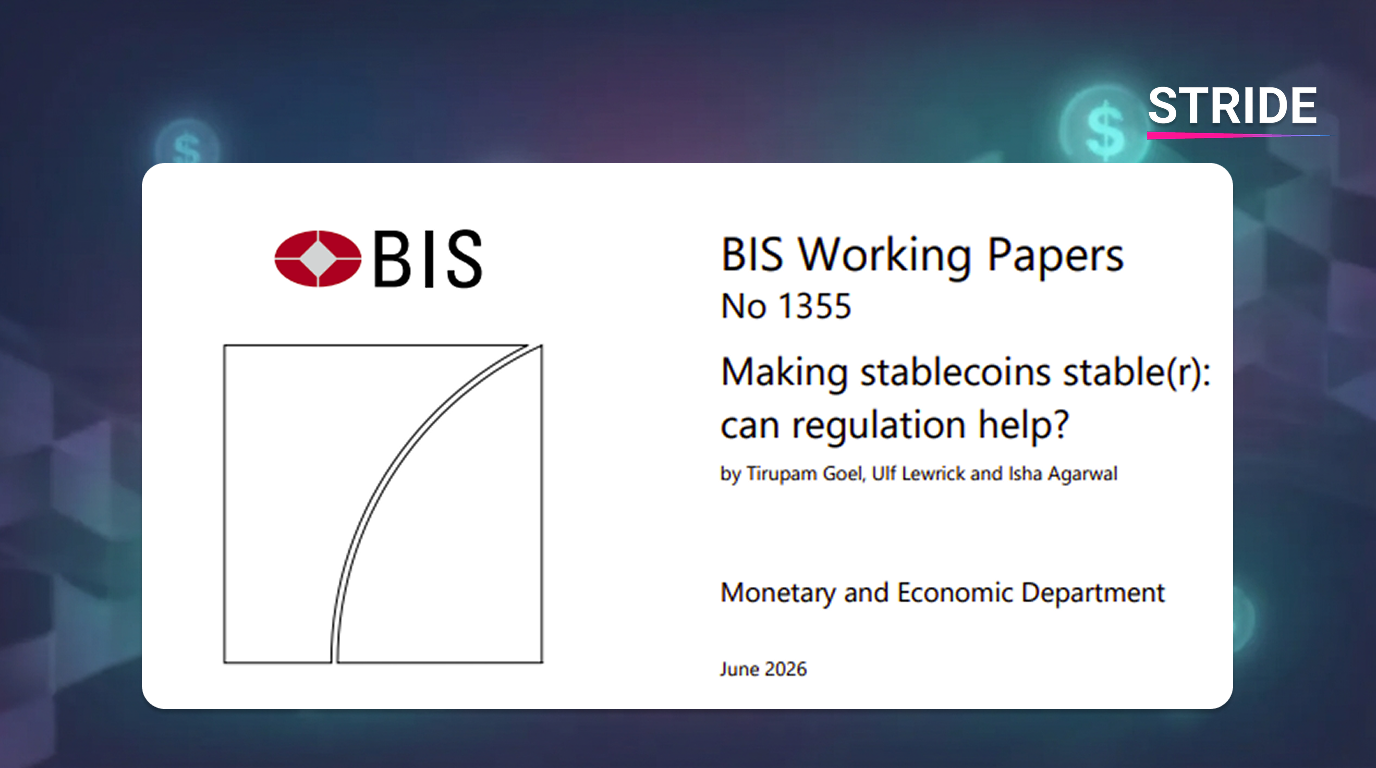
A new BIS working paper tackles this problem head-on with a formal model and real-world calibration. “Making stablecoins stable(r): can regulation help?” (BIS Working Papers No 1355, June 2026) by Tirupam Goel, Ulf Lewrick, and Isha Agarwal shows that well-designed capital and liquidity thresholds, used as flexible buffers rather than hard floors, can meaningfully reduce both issuer default risk and fire-sale spillovers without destroying the utility that makes stablecoins valuable.
Why Stablecoins Are Different (and Harder to Regulate)
The authors highlight two critical differences from traditional banks that make stablecoin regulation unique:
- Rigid balance-sheet size: Banks can elastically expand or contract their balance sheet. Stablecoin issuers’ assets and liabilities adjust mechanically with coin demand. Liquidity management is therefore central to their optimization problem.
- Liability-side vulnerability: Stablecoin holders are uninsured creditors with no yield upside and instant redeemability. There is no deposit insurance or central-bank backstop. Vulnerabilities arise from volatile redemptions that can trigger forced bond sales and liquidation spirals. Even when the assets themselves (mostly short-dated Treasuries and cash) are low-risk.
This setup creates strong incentives for issuers to hold too little capital and to favor higher-yielding but less-liquid bonds over cash. Exactly the behavior that amplifies stress.
The Regulatory Innovation: Usable Buffers That Trigger Discipline
Instead of rigid minimum requirements, the paper models capital thresholds (CR) and liquidity thresholds (LR) as reference points that issuers can breach in stress. Breaching them automatically triggers additional redemptions from coin holders. This makes flows endogenous to the issuer’s balance-sheet strength and disciplines risk-taking ex ante while preserving buffer usability during crises.
The design cleverly balances stringency and effectiveness: issuers build stronger buffers in normal times because they know breaches will be costly, yet the buffers remain available when truly needed.
Three Main Results
The model delivers three clear, policy-relevant findings:
1. Asymmetric Channels of Impact
The liquidity threshold primarily pushes issuers to hold more cash.
The capital threshold raises both capital and cash: because extra cash reduces the bond sales that would otherwise erode capital through liquidation costs and mark-to-market losses.
2. Substitutes vs. Complements for Policy Goals
More cash holdings reduce both the issuer’s probability of default (PD) and the expected price impact (EPI) on Treasuries from fire sales.
More capital reduces PD but has no direct effect on EPI.
Result: The two thresholds act as substitutes when regulators target either PD or EPI alone. However, they are complements: both are needed, when regulators want to hit joint targets for default risk and systemic spillovers.
3. Powerful Quantitative Effects
Using a two-way mapping calibrated to real data, the authors show that even modest, plausible thresholds deliver large stability gains:
- In the unregulated baseline: stressed weekly PD exceeds 15 basis points, with EPI around 4 bps.
- With a low-end calibration of LR + CR thresholds: stressed weekly PD falls to roughly 0.7 bps and EPI to 2.7 bps.
- Higher thresholds produce even stronger reductions.
The calibration is grounded in observable data: AR(1) persistence of weekly stablecoin flows estimated from a panel of major stablecoins, and price-impact parameters drawn from redemption-driven Treasury sales by US money market funds (whose portfolios closely resemble those of leading stablecoin issuers). Remaining parameters are disciplined to match observed liquidity and capital ratios of a major real-world issuer.
Policy Calibration and Welfare Trade-offs
The paper provides regulators with a practical two-way mapping: choose desired PD and EPI targets → recover the implied capital-liquidity threshold combinations (and vice versa). This is exactly the kind of tool policymakers need for evidence-based stablecoin oversight in 2026.
A stylized welfare analysis compares the benefits of lower default and spillover risks against the costs imposed on issuers (tighter constraints) and users (potential reduction in stablecoin utility or convenience). The optimal thresholds depend on how much society values the services stablecoins provide — but the framework makes those trade-offs explicit and quantifiable.
Key Takeaways for Policymakers and the Industry
- Regulation can work without killing utility. Usable buffers that trigger market discipline offer a smarter alternative to blunt prohibitions or overly rigid rules.
- Capital and liquidity rules are not interchangeable. Their interaction matters — especially when regulators care about both micro-prudential (issuer solvency) and macro-prudential (market spillovers) outcomes.
- Data-driven calibration is feasible. Real stablecoin flow dynamics and Treasury market depth already provide enough information to set meaningful thresholds.
- Stablecoins are not banks — but lessons apply selectively. The rigid balance sheet and runnable liabilities require tailored tools focused on liquidity sequencing and endogenous flow responses.
The BIS paper does not claim regulation is costless or that thresholds should be set at any particular level. It does show, rigorously and quantitatively, that thoughtful design can substantially de-risk the stablecoin ecosystem while preserving its core value proposition.
Source: BIS Working Papers No 1355, “Making stablecoins stable(r): can regulation help?” by Tirupam Goel, Ulf Lewrick, and Isha Agarwal (June 2026). All figures and results are from the paper’s model and calibration.