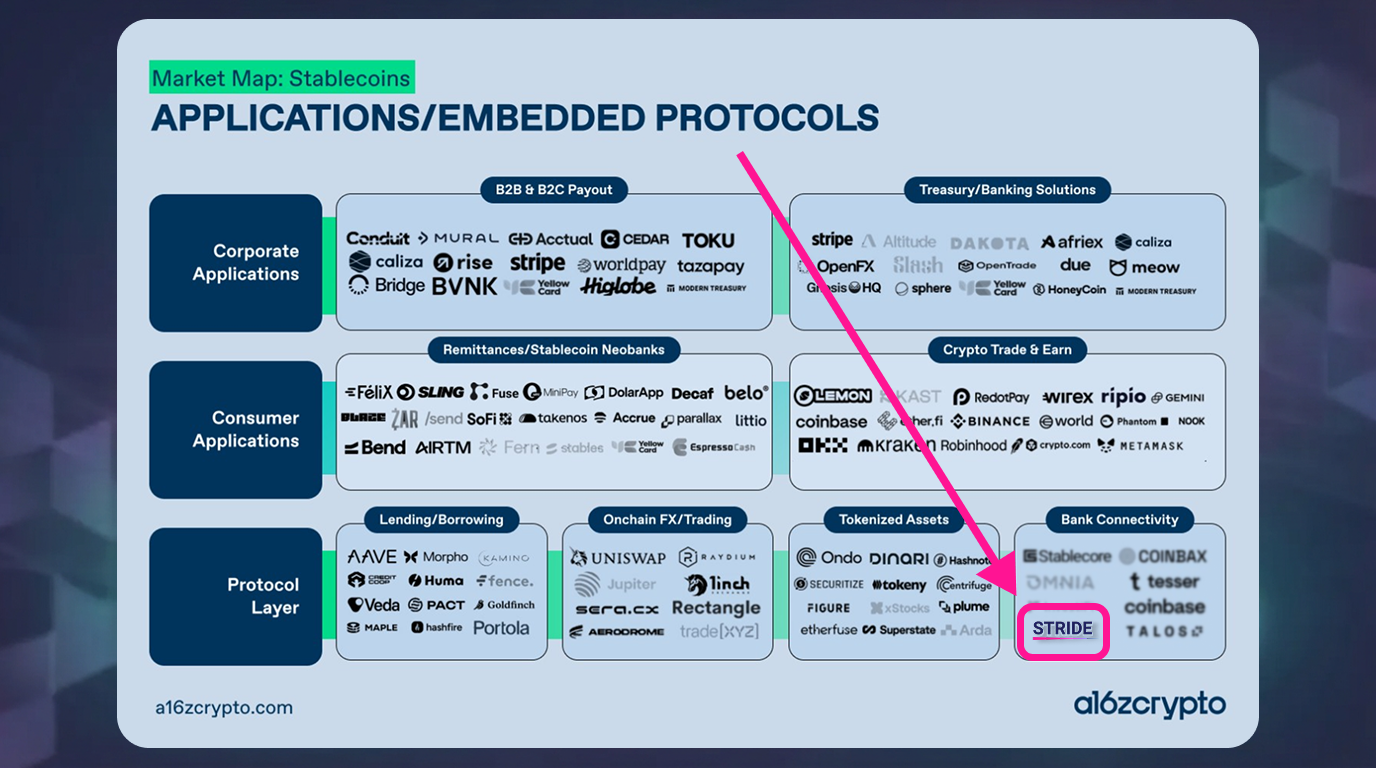
STRIDE Named in the a16z Crypto Stablecoin Market Map
On 27 April, a16z crypto published The New Stack for Global Finance: Stablecoins Edition, a comprehensive market map of the companies building the infrastructure layer beneath the next era of global finance. STRIDE is featured in the Bank Connectivity category.
That placement matters, and not because of the logo on the chart. It matters because it validates the thesis we have been building around for the past two years: that the most consequential gap in the stablecoin stack is the one between crypto-native infrastructure and the core banking systems that still process the vast majority of the world's financial activity.
What a16z sees in bank connectivity
The a16z team frames bank connectivity as what they call the "unglamorous critical layer" of the stablecoin stack. Their argument is straightforward. The stablecoin infrastructure built so far has been constructed almost entirely outside of traditional banking, by fintechs, non-bank payment companies, and crypto-native builders. That speed came at a cost: most of this infrastructure is architecturally incompatible with the legacy core systems that banks actually run.
Bridging that gap requires a dedicated translation layer. Not a rip-and-replace of bank technology, but middleware that enables banks to offer stablecoin capabilities alongside their existing systems. That is precisely what STRIDE OS was built to do.
Why this recognition is significant
a16z crypto is one of the most influential voices in digital asset infrastructure. When they publish a market map identifying the structural layers of a new financial system, it shapes how investors, builders, and institutions understand where value is forming.
Being named in the Bank Connectivity layer places STRIDE alongside the companies a16z considers essential to the functioning of the entire stack. It confirms a few things we have long believed:
The integration problem is real. Banks are not going to rebuild their core systems to accommodate stablecoins. They need infrastructure that works with what they already have. STRIDE OS, as a Dual-Rail Banking orchestration platform, is purpose-built for exactly this challenge.
Middleware is where the leverage sits. The a16z analysis makes clear that the application layer (neobanks, wallets, corporate treasury tools) cannot scale unless the banking connectivity layer beneath it works. Every stablecoin payment, every tokenised deposit, every on-ramp and off-ramp flows through this layer. STRIDE's position here is not peripheral. It is load-bearing.
The market is maturing beyond payments. a16z highlights that the most forward-thinking players in bank connectivity are already expanding into onchain lending, credit, and broader capital markets infrastructure. This tracks with our roadmap. STRIDE OS is designed to extend into these use cases as regulated institutions move further along the Dual-Rail Banking adoption curve.
What comes next
The a16z piece makes a broader point worth absorbing: the transition to onchain finance is past the point of no return. Stripe's acquisitions of Bridge and Privy, Mastercard's acquisition of BVNK, and the regulatory momentum behind the GENIUS Act all point in the same direction. Institutions are no longer asking whether stablecoins will be part of the financial system. They are asking how to integrate them without breaking what already works.
That is the question STRIDE was built to answer. And it is encouraging to see a16z mapping the landscape the same way we do.
STRIDE OS is a Dual-Rail Banking orchestration platform that enables regulated financial institutions to integrate stablecoin and tokenised asset infrastructure without rebuilding core systems. Learn more at stride.sc.