The Strongest Case for Stablecoins in Cross-Border B2B Is the One Where Nobody Sees Them
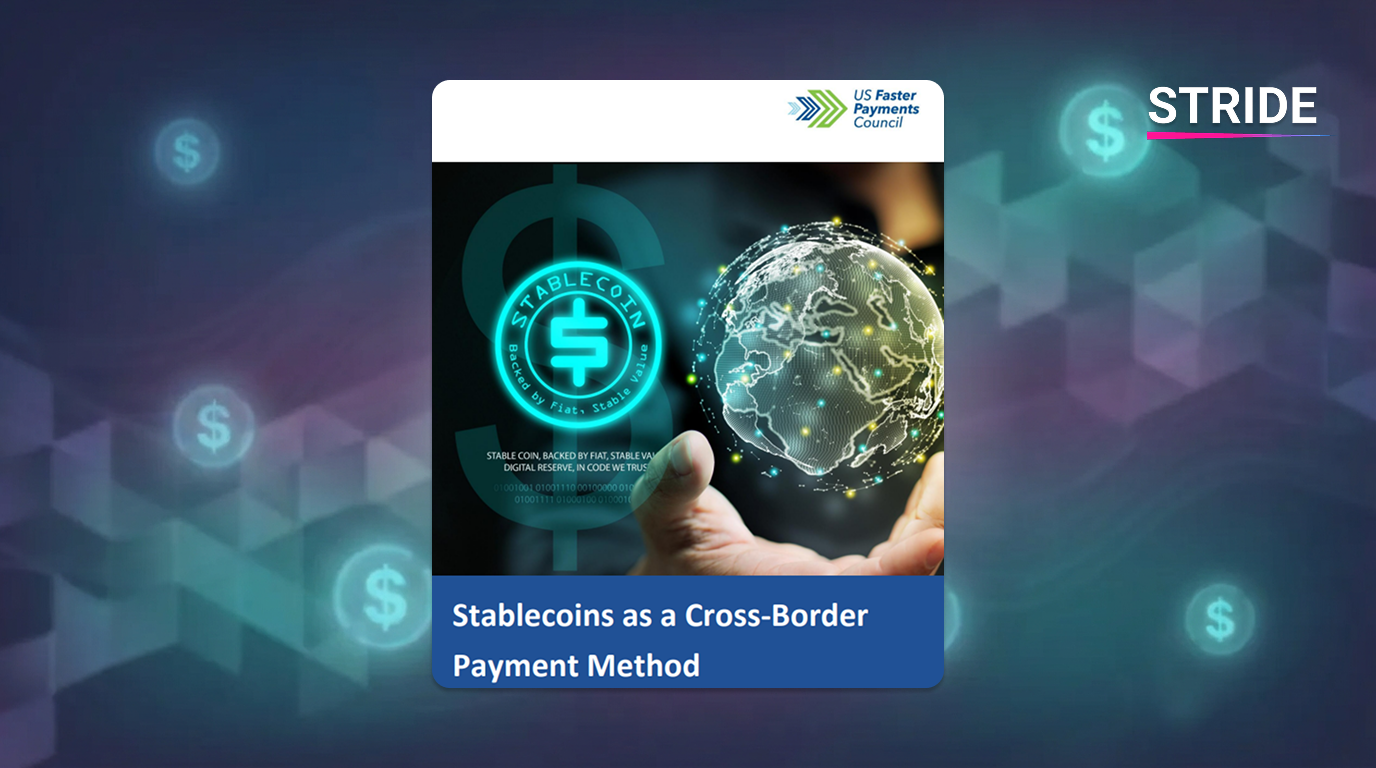
The US Faster Payments Council has published a report on stablecoins for cross-border payments, addressed to CFOs and payment strategy executives, with contributors from Visa, American Express, BNY, Nacha, ACI Worldwide, Euronet and a long list of banks and processors. Its central recommendation is that the better of the two available models is the one in which the CFO reading the report never knows stablecoins were involved at all.
That reads like a demotion, and in a sense it is. It's also probably correct, and it changes what the business case has to be built on. If the stablecoin is invisible to both counterparties, then it isn't competing on user experience, settlement speed as experienced by the payer, or any of the things that usually feature in the pitch. It's competing on what it does to the balance sheet of the institutions in the middle.
Why the timing matters more than usual
The report notes that GENIUS Act regulations remain to be written, with the statute taking effect by January 2027. That framing has aged in an interesting way in the weeks since publication.
The GENIUS Act, signed 18 July 2025, takes effect on the earlier of 18 January 2027 or 120 days after the primary federal stablecoin regulators issue final implementing rules. Most of those final rules were statutorily due by 18 July 2026, a deadline that has now passed. Between December 2025 and May 2026 the OCC, FDIC, NCUA, Treasury, FinCEN and OFAC each issued proposed rules, with comment periods running through June and July 2026. As of May, the Federal Reserve Board had not yet issued its proposed rule.
So the institutions this report is written for are being asked to make architectural decisions against a rulebook that exists mostly in draft. That's the actual context for the report's preference for the conservative model, and it's a better argument for that preference than any of the ones the report makes explicitly.
Two models, and why the direct one loses
The report sets up a clean binary. In the direct model, a buyer acquires stablecoins through an exchange, sends them to the seller's wallet address, and the seller holds, reuses or redeems them. Both parties know they're using stablecoins and both carry the compliance obligations that come with that.
In the indirect model, the buyer and seller experience a conventional wire or card transaction. Behind it, the payment service providers on each side settle with one another in stablecoins, typically on a net basis across a settlement window.
The report's case against the direct model is compliance exposure, and it's stated plainly: the same money laundering, sanctions evasion and terrorism financing risks that apply to cash, gift cards and cashier's cheques apply here, and the obligation sits with parties who are not compliance organisations. A corporate treasury team is not equipped to run sanctions screening on a wallet address. The indirect model puts that work back where the licences, the staff and the existing controls already are.
The efficiency argument for the indirect model is more specific than the usual speed claim. Net settlement can conclude on any day at any hour rather than within banking hours, and it can run directly between the sending and receiving institution without an intermediary in between. That's a treasury property, not a payments property.
The prize is trapped liquidity, and nobody agrees how big it is
Buried in the report's comparison table is the row that actually carries the economics. Under correspondent banking, separate reserve accounts must be held in every country where an institution has payment activity. Under stablecoin settlement, a single custody account can do the work.
That's the pitch. Pre-funded nostro balances sitting in a dozen currencies to guarantee settlements can clear are capital that can't be lent, invested or deployed. Replace standing balances with on-demand settlement and the capital comes back.
The difficulty is that published estimates of how much capital that is vary by two orders of magnitude. Circle, citing BIS figures, puts roughly $27 trillion in nostro and vostro accounts globally, a number now widely repeated across the sector. American Banker's on-chain glossary cites a McKinsey estimate of over $10 trillion trapped in nostro accounts. Spark's own reference material, having quoted the $27 trillion figure, then notes that estimates of actual nostro balances at major correspondent banks run between $400 billion and something over $1 trillion.
These are not measuring the same thing, and none of them is a like-for-like statement of releasable capital. Anyone building a business case on liquidity release should establish which quantity their own institution is actually holding rather than inheriting a headline number. The FPC report, to its credit, doesn't quote any of them. It also doesn't quantify the benefit at all, which is the report's main limitation: the comparison table is qualitative throughout, asserting that stablecoin fees "will be much lower" without measurement.
The counterweight the report includes and most coverage will drop
Three details in the report cut directly against the enthusiasm, and they're worth pulling out because they rarely appear in commentary on this topic.
Stablecoins can't be lent against. An institution holding stablecoins rather than fiat forfeits lending capacity unless it adopts DeFi lending or staking, which is not a realistic option for most regulated balance sheets. Trapped liquidity in a nostro account and idle stablecoin inventory are both non-earning assets. The gain is real only if inventory stays small, which is why the report says coins received in settlement will typically be burned in the absence of customer demand.
Custodians earn nothing on the float. Under GENIUS, permitted issuers may not pay holders interest or yield. The issuer captures the spread by investing reserves; the custodial institution earns servicing fees only. In a rate environment near four percent, that's a meaningful transfer of economics from the institution doing the operational work to the issuer.
The reporting layer doesn't exist yet. Stablecoins carry no information about the underlying trade. Reconciliation against invoices and trade documents needs an ISO 20022 overlay, carried either by an existing network like Swift or the card networks, or by linked off-chain servers that also have to interface with legacy systems. And multiple stablecoins are not interchangeable without a clearinghouse function of some kind, with the report naming Metallicus and Ubyx as examples. That is a substantial amount of infrastructure still to be built before the operational simplicity argument holds.
One claim deserves more hedging than it gets. The report lists, among regulatory challenges, that self-custody wallets which are not exchange-based bypass sanctions and other restrictions. That's stated more categorically than the evidence supports; whether self-hosted wallets defeat sanctions screening or merely shift where it has to be applied is an active empirical dispute, and blockchain analytics firms and FATF both work from the premise that on-chain flows remain traceable.
The yield question is live, not settled
The report describes the interest prohibition as settled architecture, noting that the OCC presumes affiliate or white-label reward arrangements violate the prohibition unless an issuer can demonstrate otherwise in writing.
That prohibition is under active contest. On 8 April 2026 the White House Council of Economic Advisers published an analysis concluding that eliminating stablecoin yield would increase total bank lending by $2.1 billion, or 0.02%, with community banks gaining about $500 million, and that the prohibition carries a net welfare cost of around $800 million. The CEA's reasoning is that only the roughly 12% of reserves held as bank deposits is genuinely removed from the credit multiplier, with the Treasury bill portion recirculating. The American Bankers Association has pushed back, and the Treasury Department has separately estimated $6.6 trillion in deposits at potential risk. The FDIC's prudential proposal maintains the prohibition.
For an institution modelling the economics of holding stablecoin inventory, that unresolved fight is a material input, and it's a live question in the CLARITY Act negotiation rather than a closed one. This is the same deposit-migration question a BIS working paper examined from the macroeconomic side, which we looked at when asking what happens to bank funding and government budgets if the market reaches $2 trillion.
What this means for each group
Banks and payment service providers. The report's operational recommendation is that institutions coordinate through a consortium or third party rather than solving fraud controls, identity, compliance and off-ramp mechanics individually, on the reasoning that isolated efforts force every participant to validate every other participant's controls. That's the same conclusion J.P. Morgan's Kinexys team and MIT reached from a different direction when they published the list of problems banks on public blockchains can't fix alone.
Corporate treasurers. If the indirect model prevails, the decision in front of a treasury team isn't whether to adopt stablecoins. It's which providers to bank with, and what settlement finality and exception handling those providers can contractually commit to. The report is explicit that transparency at the protocol layer doesn't become usable without a notification and status layer built on top.
Compliance functions. The report states that compliance requirements for stablecoins are the same as for cash-based payments and could be greater, given the difficulty of getting required data on chain while maintaining confidentiality. Off-chain linkage solves it and adds cost, time and overhead. Nobody should be modelling this as a compliance saving.
Institutions operating across multiple jurisdictions. The report flags that stablecoins are not legally supported everywhere, which creates conversion problems for local institutions and pushes the off-ramp onto exchanges. Mapping where that constraint bites is a prerequisite for any corridor plan, and our free Stablecoin Regulation Tracker covers licensing regimes across 200+ jurisdictions.
The takeaway
The report estimates that stablecoin holdings likely now exceed $300 billion, extrapolating from a BIS figure of $255 billion in July 2025. That inference holds: DefiLlama data tracked through mid-July 2026 puts the market near $303 billion, though it has been contracting since a May peak around $320 billion rather than climbing.
What's more interesting than the number is what the report implies about where this goes. If the winning model is the invisible one, then stablecoins in cross-border B2B don't arrive as a product launch. They arrive as a change in how two payment providers settle with each other, announced to nobody, showing up on the customer's side as marginally better pricing and a wire that clears on a Sunday.
That's a less exciting story than the one usually told about this technology. It's also the version that requires the fewest people to change their behaviour, which historically is the version that happens.
Source: "Stablecoins as a Cross-Border Payment Method," US Faster Payments Council, Cross-Border Payments Work Group and Digital Assets Work Group, July 2026.
GENIUS Act rulemaking status and effective-date mechanics are drawn from the OCC's February 2026 bulletin on its notice of proposed rulemaking and from Chapman and Cutler's GENIUS Act rulemaking tracker. Council of Economic Advisers findings are from "Effects of Stablecoin Yield Prohibition on Bank Lending," published 8 April 2026, as reported by Forbes, Ledger Insights and the ABA Banking Journal. Nostro and vostro liquidity estimates are attributed to Circle, American Banker and Spark as cited in the text. Stablecoin market capitalisation figures are from DefiLlama data as reported by Stablecoin Beat.
Methodology note: we focused on the two-scenario comparison, the balance sheet and compliance considerations, and the operational gaps identified in the challenges section, rather than summarising the report section by section.
This article is for informational purposes only and does not constitute financial, investment, or legal advice.