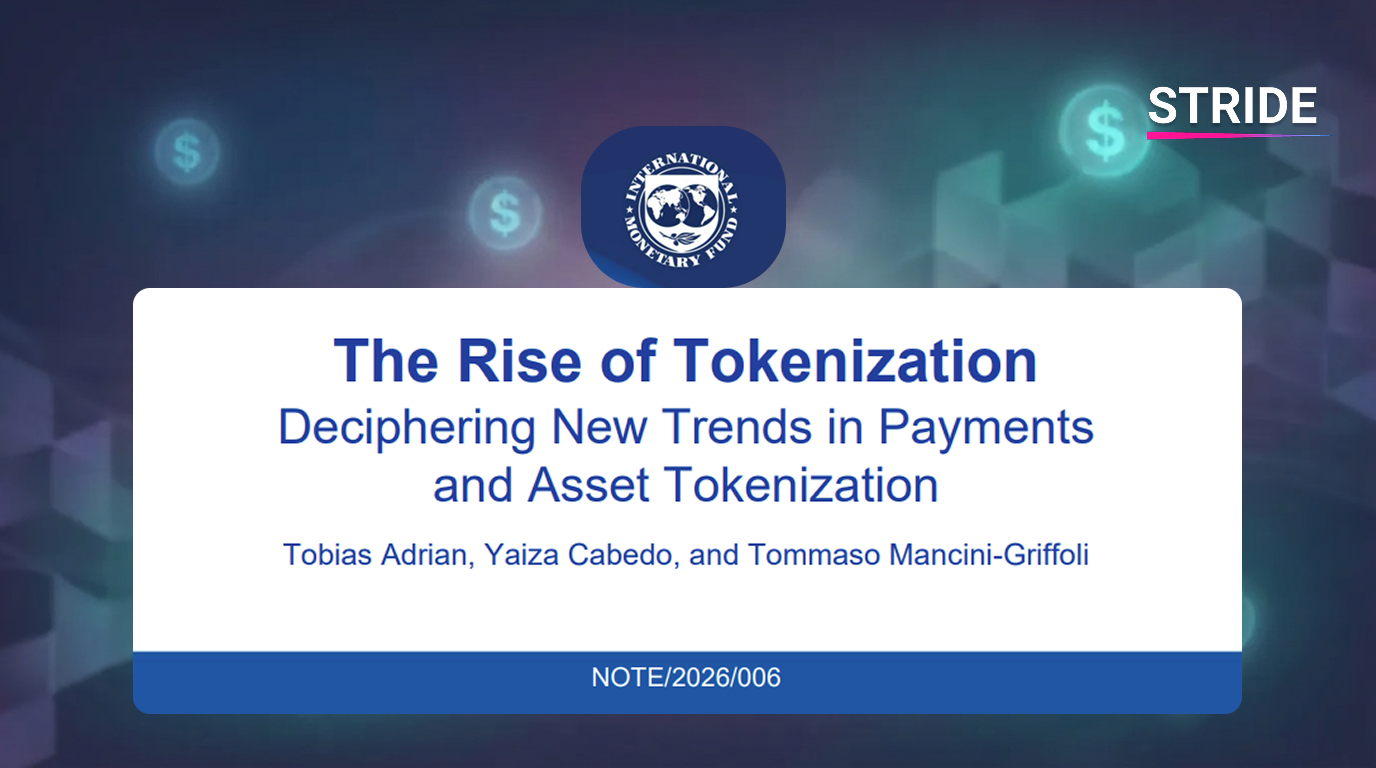
Tokenization in TradFi: IMF Maps the Future of Financial Infrastructure
Tokenization Has Arrived in Traditional Finance. The Real Questions Are About Infrastructure, Money, and Who Sets the Rules
For years, the tokenization debate was about whether it would happen. That question is now settled by the numbers, and a harder set of questions has taken its place: who runs the infrastructure, what counts as money on these new rails, and which rules apply when something breaks. An IMF Note from July 2026 is one of the clearest maps yet of that new terrain.
This post breaks down the note's framework, puts it in context against how fast the market has actually moved, and looks at what the analysis implies for banks, fintechs, and policymakers. We've focused on the note's structural arguments (the layer model, the interoperability choices, and the money question) rather than its full survey of initiatives.
Why Now? The Market Stopped Waiting
The IMF's timing isn't academic. The tokenized asset market spent 2024 and 2025 producing eye-catching growth rates, and 2026 is the year the infrastructure caught up.
The numbers first: tokenized real-world assets grew from roughly $6 billion in early 2025 to over $31 billion by May 2026, and tokenized US Treasuries alone crossed $10 billion in February 2026, reaching $13.4 billion by early April, led by products from Circle, BlackRock, Ondo, and Franklin Templeton.
The institutional and regulatory moves matter even more than the totals:
- Nasdaq, the NYSE, and the DTCC all moved in Q1 2026 toward integrating tokenized securities into the existing architecture of regulated markets.
- The SEC's Division of Corporation Finance issued its first formal statement on tokenized securities in January 2026, clarifying that tokenized securities are securities, with the framework applying based on economic function rather than technological format.
- The ECB confirmed that assets issued using distributed ledger technology became eligible collateral for Eurosystem credit operations as of March 30, 2026.
When central banks accept tokenized instruments as collateral and the largest market operators integrate them into regulated infrastructure, tokenization stops being a pilot category. The IMF note is best read as a framework for the decisions that follow from that.
The Three-Layer Stack
The note's core analytical move is a clean three-layer framework that applies to both traditional and tokenized finance:
- Infrastructure layer: the rails where ownership is recorded and transactions settle, whether blockchains or traditional databases and payment systems.
- Asset layer: the actual claims, including bank deposits, stablecoins, central bank reserves, and securities.
- Services layer: the wallets, exchanges, and applications people interact with.
In traditional finance, commercial banks have historically sat across all three layers in a vertically integrated model. Tokenization breaks that integration apart. A stablecoin can be issued by one entity, settled on a public blockchain run by many participants, and accessed through a third-party wallet. That's the note's central insight: tokenization decouples who issues assets from who operates the infrastructure, and that separation reshapes incentives, risks, and the role of public institutions.
Infrastructure Is Converging on Hybrids
Early crypto-native firms pushed for fully public, permissionless blockchains like Ethereum and Solana, drawn by openness, standardization, and network effects. Many banks started at the opposite end, with private, permissioned ledgers built for control and privacy.
Reality is landing in the middle:
- Fintechs such as Circle, Coinbase, and Stripe are adding centralized elements (sequencing, approved validators, or Layer 2 controls) for speed, predictable fees, and easier compliance.
- Banks including JPMorgan, UBS, and Société Générale are moving some issuance onto public permissionless chains, but with whitelisting and permission controls layered on top.
- Swift is building an EVM-compatible shared ledger it will operate, while banks keep control over their own keys and settlement.
- A group of major US banks is building a network through The Clearing House to clear tokenized deposits, with final settlement in central bank reserves.
The pattern: public infrastructure for connectivity and innovation, paired with the governance and access controls institutions require. Pure permissionless and pure permissioned models are both giving way to pragmatic compromises.
Interoperability Will Determine Who Wins
The most decision-relevant part of the note is its breakdown of three ways to move assets across different ledgers:
- Single ledger: everything happens on one shared ledger. Highest functionality and true atomic settlement with no settlement risk, but it concentrates activity and raises hard governance questions.
- Compatible ledger: assets stay on separate ledgers while an orchestrating entity coordinates instructions across them. More practical in the near term and less centralized.
- Common ledger: assets move to an intermediary ledger for settlement. This enables interoperability but introduces counterparty and concentration risk, because the operator holds assets in escrow.
Each model trades off atomicity, operational risk, governance complexity, and market power differently. There's no free option, only a choice of which risks to accept for which efficiency gains.
Tokenized Deposits vs Stablecoins: Different Animals
The note draws a line that's easy to blur and expensive to get wrong.
Tokenized deposits are still bank liabilities, and regulation will largely decide the distribution model. The direct model, where the bank knows the end user, stays closest to today's framework. Wholesale or tiered models, where intermediaries distribute or issue their own tokens backed by deposits, could expand reach but raise questions about who handles KYC and transaction monitoring.
Stablecoins already behave more like securities than like traditional money. They move peer-to-peer between users who have no relationship with the issuer. That's flexible, but it raises questions about loss absorption and redemption under stress. The IMF's point is sharp: holding a stable face value in every state of the world takes credible loss-absorption capacity beyond reserve assets and issuer capital alone. The macroeconomic side of that same question, what large-scale stablecoin adoption does to bank funding and government borrowing costs, is modeled in a recent BIS working paper we covered in a separate analysis.
On central bank involvement, the note describes a spectrum from "self-service" (the current reality for most stablecoins) to "full service" models approaching a synthetic CBDC, with partial and light-service options in between. Where each jurisdiction lands on that spectrum is one of the things worth tracking as frameworks firm up; our Stablecoin Regulation Tracker follows the moving pieces.
What This Implies for Different Stakeholders
- For banks, infrastructure choices are no longer purely technical. They shape governance, legal finality, compliance costs, and competitive positioning. The hybrid pattern is winning because it balances public-network benefits with institutional controls, which suggests the relevant skill is orchestration across layers rather than owning all of them.
- For fintechs and issuers, the direction of travel is toward more structure, not less: approved validators, whitelisting, and formal recognition that tokenized securities are securities. The compliance perimeter is arriving; the question is building for it early or retrofitting later.
- For policymakers, the note surfaces questions that won't resolve themselves: how oversight adapts when there's no single operator, what legal frameworks recognize settlement finality across architectures, how far central banks should push convergence on standards, and when private infrastructures performing systemic functions should be licensed like traditional financial market infrastructures.
- For market designers, the note offers a genuinely contrarian caution: instant atomic settlement isn't unambiguously better. It removes settlement risk, but it can reduce the liquidity and flexibility current markets rely on, and prefunding brings costs of its own.
The Bottom Line
Tokenization isn't simply "crypto coming to traditional finance." It's a reconfiguration of the financial stack that loosens the link between who issues an asset and who operates the rails it moves on. The market data says this is no longer a forecast, and the regulatory record from early 2026 says the rulemakers have noticed.
The IMF note doesn't hand out easy answers, and that's its value. It maps the terrain: single vs compatible vs common ledgers, hybrid governance, and the distribution models for tokenized liabilities. The people who understand those architecture choices will be better positioned to see where real value is being created and where new risks are quietly building up.
The technology has moved fast. The rules and governance sitting on top of it will decide whether tokenization delivers on its promise or just recreates today's frictions in a new form.
Source: IMF Note 2026/006, "The Rise of Tokenization: Deciphering New Trends in Payments and Asset Tokenization," by Tobias Adrian, Yaiza Cabedo, and Tommaso Mancini-Griffoli, July 2026. Market figures are drawn from RWA.xyz data and public SEC and ECB statements. We focused on the note's structural framework rather than its full survey of market initiatives.
This article is for informational purposes only and does not constitute financial, investment, or legal advice.