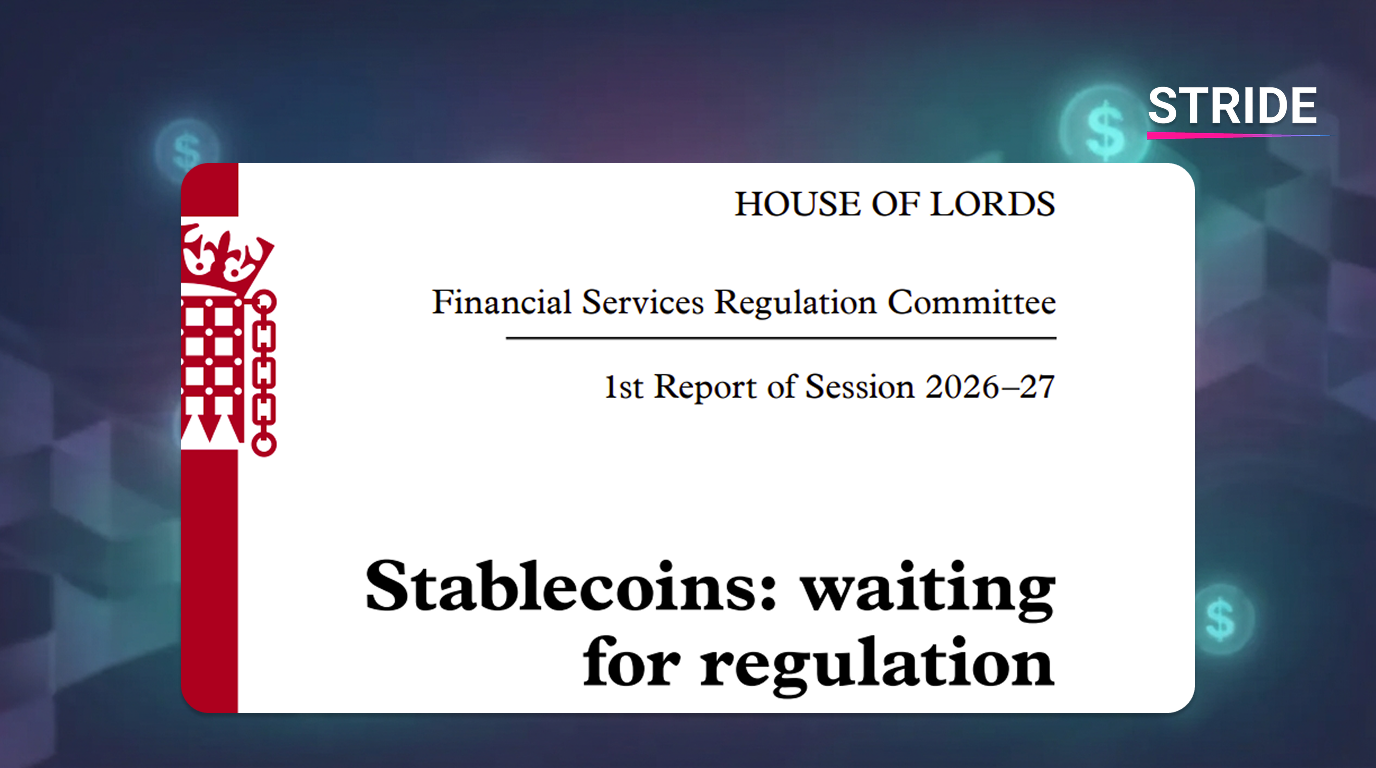
UK Stablecoin Regulation: Why the House of Lords Says We’re Moving Too Slowly
UK Stablecoin Regulation: The House of Lords Says We’re Waiting Too Long
The global stablecoin market has grown to around $310–320 billion. It is overwhelmingly dominated by US dollar tokens, with Tether and Circle together accounting for roughly 90 percent of that total. In the UK, by contrast, the picture is almost nonexistent. The only live sterling-referenced stablecoin has a market cap of just $1.53 million.
A new report from the House of Lords Financial Services Regulation Committee argues that this gap is not accidental. It is the direct result of regulatory uncertainty that has held back issuers, investors, and innovation. The Committee’s verdict is clear: the UK has good proposals on the table, but it is moving too slowly and some of the detail needs adjustment if a meaningful sterling stablecoin market is ever going to emerge.
What Stablecoins Actually Do Today
The report is careful to ground its analysis in evidence rather than hype. Right now, the dominant uses for stablecoins are inside crypto markets — settling trades and providing a relatively stable bridge between volatile tokens. Cross-border payments are the second clear use case, especially for businesses moving money between jurisdictions where traditional correspondent banking is slow and expensive. Witnesses described potential cost reductions of up to 80 percent for regular international transfers.
Other applications are still small but growing. Stablecoins are already being tested for treasury management inside digital-native companies and for settlement in tokenised capital markets. The technology’s programmability — the ability to trigger payments automatically when conditions are met — opens doors to things like automated payroll, conditional trade finance, and even agentic commerce where AI agents handle purchases directly.
The Committee notes that these use cases complement rather than replace existing payment rails. Stablecoins are not about to displace the UK’s fast and cheap domestic bank transfers for most consumers. Their real value lies in areas where speed, 24/7 availability, and composability with blockchain-based assets matter most.
The Risks Are Real — But So Is the Opportunity
The report does not downplay the downsides. Stablecoins are runnable instruments: holders can redeem at par, so any loss of confidence can trigger rapid outflows. Liquidity and reserve management risks are genuine, as are concerns about contagion if problems in one stablecoin spill into others or into traditional markets.
On the monetary policy side, large-scale deposit migration from banks into stablecoins could raise banks’ funding costs and affect credit availability. The Bank of England has modelled this scenario and takes it seriously. Currency substitution is another worry — if non-sterling stablecoins became the default digital money for UK transactions, it would weaken sterling’s role and complicate monetary control.
Consumer protection gaps are also flagged. Blockchain transactions are fast and effectively irreversible, with limited scope for fraud disputes or refunds compared with card payments or bank transfers. There is no Financial Services Compensation Scheme safety net. Illicit finance is a further concern: stablecoins already feature in a high share of on-chain criminal activity, even if that activity remains a small percentage of total volume.
Yet the Committee’s tone is pragmatic rather than alarmist. It recognises that banning or over-regulating stablecoins would simply hand the market to foreign issuers. The goal is proportionate rules that allow innovation while managing the real risks.
What the UK Is Proposing — and Where It Falls Short
The current UK regime for stablecoins is thin — basically AML rules and the financial promotions regime. That changes from late 2027 when the FCA’s new cryptoasset framework comes into force. Non-systemic stablecoins will be authorised and supervised by the FCA. Systemic ones (those used widely for payments or as settlement assets in wholesale markets) will face dual regulation: the Bank of England on prudential matters and the FCA on conduct.
The Committee supports the core architecture. One-to-one backing with high-quality assets, clear redemption rights, segregation of reserves, and proper disclosure all make sense. The Bank’s proposed backstop lending facility is welcomed as a confidence-building measure.
However, the report highlights several areas where the proposals look poorly calibrated:
- The Bank’s requirement that systemic issuers hold at least 40 percent of backing assets in unremunerated central bank deposits has drawn heavy criticism. Issuers argue it would damage viability and make the UK less competitive internationally.
- Redemption at par by the end of the next business day sounds consumer-friendly but creates significant operational burdens for issuers.
- Temporary holding limits on systemic stablecoins are seen as impractical and likely to stifle growth before the market even gets going.
- There is still too much uncertainty about when a stablecoin becomes systemic, how the transition from FCA-only to dual regulation will work, and exactly which stablecoins will fall into the payments regulatory perimeter.
The Committee also notes that the UK is now behind both the United States (GENIUS Act) and the European Union (MiCAR). Continued delay risks entrenching dollar dominance and discouraging sterling-denominated issuance.
What Needs to Happen Next
The report’s central message is straightforward. The UK has a sophisticated financial services industry and a genuine opportunity to build a sterling stablecoin market that supports tokenisation, cross-border efficiency, and new forms of programmable finance. But that market will not develop without clear, timely, and well-calibrated regulation.
The Government and regulators should stick to the timelines they have set. They should also revisit the most contentious elements — the 40 percent central bank deposit rule, the redemption timeline, and holding limits — to ensure the regime supports innovation rather than unintentionally suppressing it. Greater clarity on the transition to dual regulation and the payments perimeter is essential so issuers can plan and invest.
Stablecoins are not a silver bullet, and they are not without risk. But they are part of a broader shift toward tokenised finance that is already underway globally. The House of Lords report makes a strong case that the UK cannot afford to keep waiting on the sidelines.
Source: House of Lords Financial Services Regulation Committee, Stablecoins: waiting for regulation (1st Report of Session 2026–27, HL Paper 6), published 3 June 2026.