MiCA Regulates Issuers, Not Stablecoins. Three Cases That Test the Difference.
Most explanations of MiCA start with the token. Is it an e-money token, an asset-referenced token, or something else? Get the classification right and the rules follow.
That framing is backwards, and three live cases in the European market are exposing why. MiCA's classifications describe assets, but almost every substantive obligation in the regulation attaches to a person: an issuer, an offeror, a person seeking admission to trading, a service provider. When the asset and the person come apart, the rulebook has no obvious answer. And the ways they can come apart turn out to be more varied than the drafters appear to have anticipated.
This piece works through three of them: a Swiss franc stablecoin that says nobody issued it, a dollar stablecoin nobody can authorize, and a platform that has separated issuance into parts that different companies hold. We've focused on the mechanics of where legal responsibility sits rather than on the merits of any individual project.
Why this is surfacing now
Three things converged in the first half of 2026.
In February 2026, the European Commission answered a long-pending question routed through ESMA's Q&A process (QA 2552) on how white paper rules apply when nobody issued the asset. The answer was that crypto-assets without an identifiable issuer fall outside Title II entirely, that no white paper is required for them, and that Article 5(2) therefore doesn't reach them. It also placed a duty on trading venues: a platform admitting an asset must itself determine whether an identifiable issuer exists.
In June 2026, a MiCA-format white paper for Frankencoin (ZCHF) appeared in ESMA's interim register, notified through the Maltese competent authority by an entity called MiCA Crypto Alliance OpCo Limited. According to Frankencoin's own compliance page, the register entry was last updated on 16 June 2026. The document is a voluntary filing for an asset the filer says isn't subject to the rules requiring it.
And on 1 July 2026, the transitional period for service providers operating under legacy national regimes closed. Venues serving EU customers are now inside the full authorization regime, which means the listing decisions they make carry direct supervisory consequences.
The amounts involved are still small. CoinGecko's Swiss franc stablecoin category carried a total market capitalization of roughly $41.5 million in 2026, with Frankencoin the largest constituent. But the precedent being set has nothing to do with the size of the asset.
The definition and the duty were written for two different things
MiCA defines an e-money token as a crypto-asset that purports to maintain a stable value by referencing the value of one official currency. That's the whole test. It says nothing about reserves, nothing about who runs the thing, and nothing about redemption.
The obligations tell a different story. Article 48 provides that a person shall not offer to the public or seek admission to trading of an e-money token in the Union unless that person is the issuer and is authorized as a credit institution or an electronic money institution, with a white paper notified and published. Redemption at par is a separate duty owed by that issuer. Reserve rules, governance rules, and disclosure rules all assume somebody is there to follow them.
So the classification is a property of the asset, and the compliance regime is a property of a company. Recital 22 papers over the join by stating that crypto-assets with no identifiable issuer should fall outside Titles II, III and IV. A recital is an interpretive aid, not an operative provision, and Article 48 contains no decentralization carve-out in its own text. The Commission's February answer resolved this for Title II. It said nothing about Title IV.
That unresolved half is where all three cases sit.
Case one: the asset that argues nobody issued it
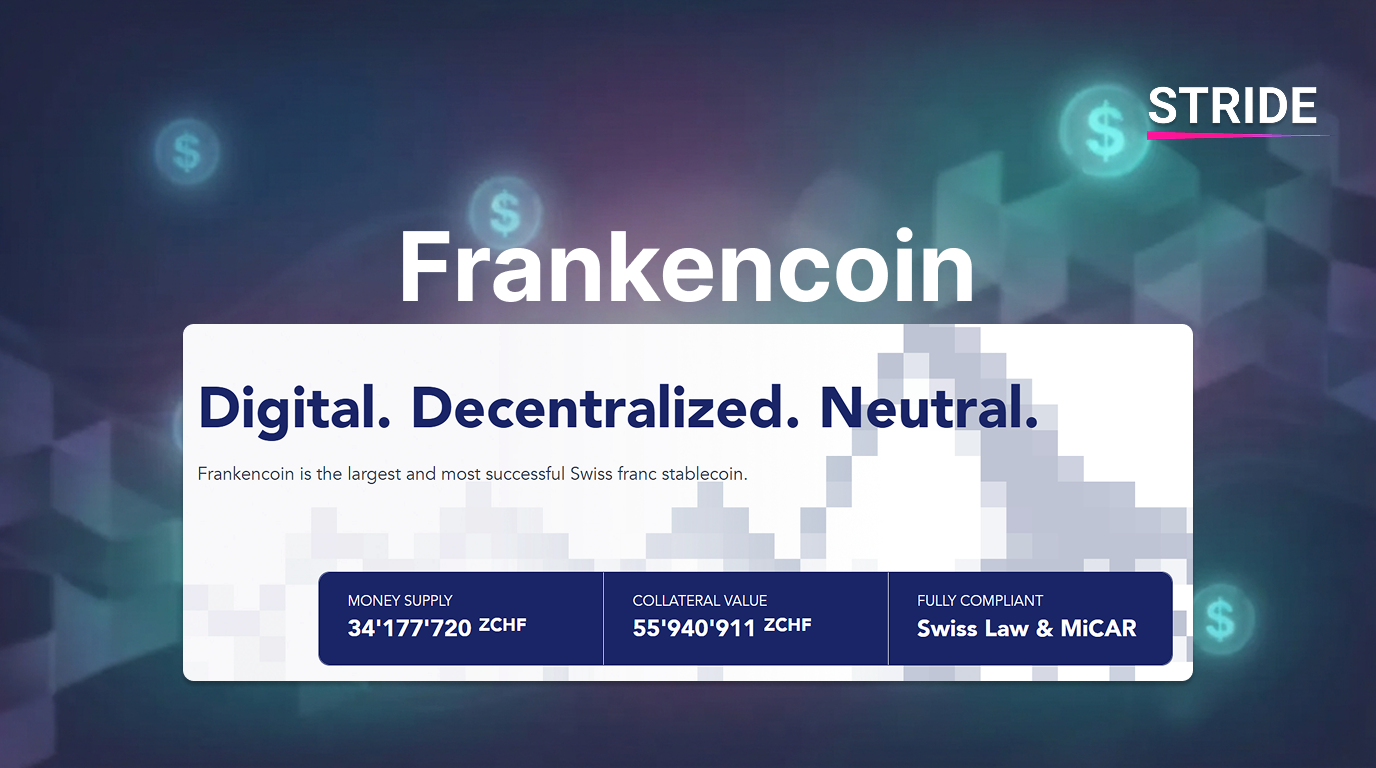
Frankencoin describes ZCHF as a Swiss franc stablecoin. Its own materials call it the largest and most successful one. Under the definition above, that's an e-money token on its face.
The mechanics are worth being precise about, because they're often described loosely. No francs enter the system at any point. Users deposit crypto collateral such as ETH or WBTC at high collateralization ratios and mint ZCHF against it, in what the protocol itself compares to a secured lending facility. There are no external price oracles; liquidations run through a challenge-and-auction process where bidders establish the collateral price. The "reserves" people refer to are loss-absorbing equity denominated in ZCHF, closer to a capital buffer than to a redemption pool.
Critically, only the borrower can get anything back, and what they get back is their own collateral after repaying the debt. A third party who buys ZCHF on an exchange holds no claim against anyone. The peg is maintained by arbitrage rather than redemption, and Frankencoin's own safety disclosures record several depeg events, with a worst deviation of 230 basis points.
The legal position published by the project, prepared by LEXR Germany in February 2026, runs as follows: there is no entity with central control over the creation of ZCHF, minting is user-driven, governance is decentralized, and no oracle or central party controls the system. Because no issuer is identifiable, Titles II, III and IV don't apply, and no white paper is required. The Maltese filing was made anyway, voluntarily, to make listing easier for trading venues.
Note what that argument does not say. It doesn't say ZCHF fails the e-money token definition. It goes straight to the absence of an addressee for the obligations. That's a scope argument rather than a classification argument, and the distinction matters: if a supervisor concluded ZCHF meets the definition, the absence of a redemption claim wouldn't rescue it. It would make it an e-money token that could never comply, because there'd be nobody to redeem against.
There's a further wrinkle. Frankencoin operates a savings module paying holders a governance-set yield funded by borrower interest. MiCA prohibits granting interest in relation to e-money tokens. A yield feature is therefore a second, independent exposure if the classification ever went the other way, and it's the part of the structure that gets the least attention. Where yield comes from, and what it implies about the obligations sitting behind a token, is a question we've looked at before in a different context.
Case two: the asset nobody can authorize
DAI reached the opposite outcome from the same starting premise, and it got there first.
In March 2025, Binance removed spot trading pairs for nine stablecoins for European Economic Area users, DAI among them, alongside USDT, TUSD, FDUSD and others. The Block reported the change at the time, and Coinbase, Kraken and Crypto.com made comparable moves. DAI remained without MiCA authorization through 2026, and the reason given is that there's no issuer entity to authorize.
So decentralization did not produce an exemption here. It produced an asset that is structurally incapable of holding a license, and venues responded by removing it rather than testing the theory. Holding and withdrawing continued to work, since ESMA's guidance distinguishes custody and transfer from an offer to the public. But acquisition through a regulated venue stopped.
The interesting comparison is that DAI's case for issuerlessness is considerably weaker than Frankencoin's. It relies on governance-controlled oracles, has used centrally issued stablecoins in its peg mechanism, holds real-world asset exposures through vehicles with real legal counterparties, and has an active governance process with named contributors. If the functional question is who controls issuance, collateral, upgrades and economic benefit, DAI has more answers on offer than ZCHF does. Yet ZCHF has a filing in ESMA's register and DAI does not, which tells you the outcome is being driven by procedure rather than by structure.
Case three: issuance unbundled into parts
The third case has nothing to do with decentralization, and it may matter more.
Startale Group launched Startale USD (USDSC) in December 2025 for the Soneium ecosystem, built on M0's stablecoin platform. It's fully backed by short-term US Treasuries held in bankruptcy-remote structures, with a claim on reserves, independent verification, and an in-app vault paying yield. On every measure that regulators say they care about, it looks like the well-behaved end of the market.
It's also unambiguously an e-money token by definition, with an identifiable issuer, and no EU authorization. Reserve quality is not a defense to a licensing requirement, and was never the test.
But the structural point isn't that a Japanese company hasn't sought an EU license for a token aimed at a Japanese and Asian user base. It's the division of labor the platform model creates. M0 supplies the minting rails, the reserve plumbing and the legal structuring. The partner supplies the brand and, crucially, the regulatory identity. The model is license-agnostic by design: in the United States the partner holds the relevant federal or state status, and in the EU the partner would need to be an electronic money institution.
MiCA assumes those functions sit inside one company. Under a platform model, a supervisor authorizing an e-money token would be licensing an entity that operates neither the reserves nor the contracts, with the core function outsourced to an infrastructure provider the authority has no direct relationship with. The available tools are outsourcing and critical third-party rules rather than anything native to MiCA. And if one platform came to power several authorized tokens across different member states, no individual Article 48 assessment would capture the concentration, because each application would look complete on its own.
What this means for each group
For trading venues. Article 48 places the prohibition on the person offering or seeking admission, not on the protocol. The Commission has confirmed through ESMA's Q&A process that a platform listing an e-money token whose issuer isn't authorized is itself treated as the person seeking admission to trading. Where an asset has no issuer at all, the enforcement risk has nowhere to land except the venue. Venues are also now expected to determine for themselves whether an identifiable issuer exists.
For banks and payment institutions. The practical distinction is between assets that are blocked but curable and assets that are blocked and incurable. USDSC needs an authorized entity to become issuer of record, which is a commercial decision. DAI has no such path without restructuring. That difference determines whether building redemption or settlement support for an asset is a waiting game or a dead end.
For supervisors. Two questions remain open in the operative text. Whether an asset can satisfy the e-money token definition where no issuer exists, and how "identifiable issuer" should be read where control is real but distributed. A functional test focused on who governs issuance, collateral and upgrades would answer both. The forthcoming MiCA review is the natural venue.
For issuers and infrastructure providers. The compliance surface is moving away from the token and toward the arrangement. Who holds the license, who runs the reserves, and who can be served with an order are becoming three separate questions with three potentially different answers.
The takeaway: the perimeter is drawn around people
The EU didn't write a rulebook for stablecoins. It wrote a rulebook for the companies that issue and distribute them, and then defined the assets those companies handle. That works cleanly when one company does everything, which described the market when MiCA was drafted.
It works less cleanly now. A protocol can distribute control until no addressee remains. A platform can separate issuance into components that different companies hold. In both cases the asset behaves like a stablecoin and the regulation struggles to say whose problem it is.
Which is why a simple compliant or non-compliant flag conceals more than it reveals. An asset can be outside the perimeter by argument, blocked but curable, or blocked with no path forward, and those three states call for entirely different decisions from anyone building around them. Tracking which regimes are live is the easy part; tracking who each regime can actually reach is the harder one, and it's the distinction our free Stablecoin Regulation Tracker is built to make legible across 200+ markets.
None of this is a story about decentralization defeating regulation. It's a story about a rulebook that assumed the issuer and the operator were the same company, in a market that is steadily proving otherwise. It's the same pattern we found looking at why distribution rather than token design decides outcomes: the value, and now the liability, sits with whoever occupies the connecting position.
Source: "The Frankencoin Case: Does MiCAR Contain a Regulatory Gap for Issuerless Stablecoins?" (2026). Primary documents referenced: Regulation (EU) 2023/1114 (MiCA), Recital 22 and Articles 3, 5, 48 and 50; ESMA Q&A 2404 and Q&A 2552, both answered by the European Commission; the ZCHF MiCA classification summary by LEXR Germany Rechtsanwalts GmbH dated 9 February 2026; and the ZCHF and FPS Swiss classification summary by LEXR Law Switzerland AG dated 14 August 2024. Stablecoin delisting figures from The Block, March 2025. Swiss franc stablecoin market capitalization from CoinGecko. Startale USD details from Startale Group and CoinDesk, December 2025. Methodology note: this analysis reorganizes the source material around where legal responsibility sits rather than following the source's structure, and adds two comparison cases not discussed in the original.
This article is for informational purposes only and does not constitute financial, investment, or legal advice.