The Dollar Already Went Around the Banking System Once. Stablecoins Are Doing It Again
For decades, the standard tool a central bank reached for when its citizens started fleeing the local currency was a rule: require approval to open a foreign currency account, cap what people can hold, restrict how dollars cross the border. These measures were never perfect, but they worked well enough that they became a fixture of macro-financial policy across emerging markets. A new working paper from the Bank for International Settlements asks a pointed question about that toolkit. If the next wave of dollarisation arrives through stablecoins rather than bank deposits, do any of those rules still bite?
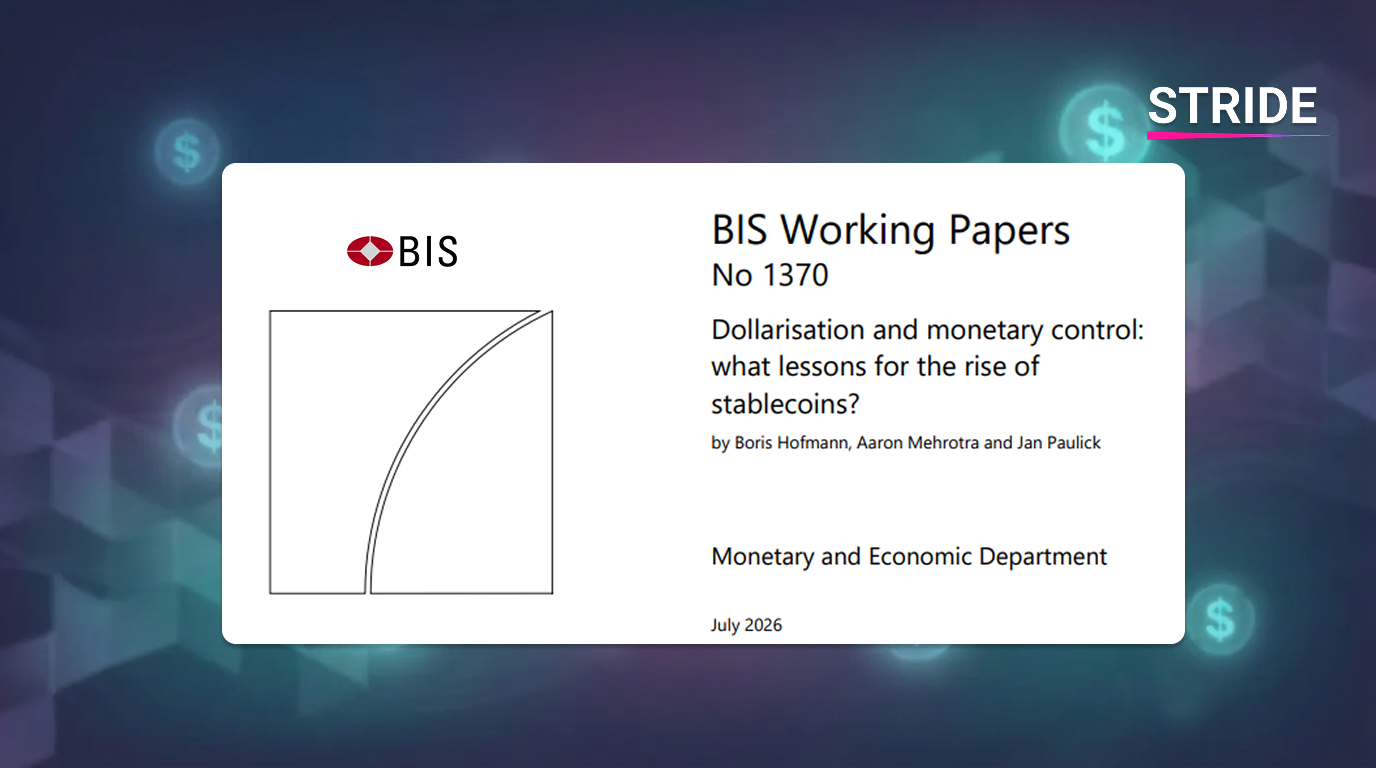
The paper, by Boris Hofmann, Aaron Mehrotra, and Jan Paulick, treats stablecoins not as a novel crypto curiosity but as the newest chapter in a very old story: people in economies with fragile currencies reaching for the dollar as a store of value. We focused on the parts of the analysis most relevant to institutions and policymakers weighing how to respond, rather than the full econometric treatment.
Why this comparison matters now
Dollar-pegged stablecoins have grown from a trading-desk utility into something large enough that central banks have to model it. Total stablecoin market capitalisation reached roughly $313 billion by the end of June 2026, according to DeFiLlama data, up about 23% year over year and nearly double the level of two years earlier. Almost all of that supply is dollar-denominated.
The reason a store-of-value asset that lives on public blockchains matters to a central bank in a smaller economy is straightforward once you see the parallel the BIS authors draw. Holding dollars used to mean holding a dollar bank deposit, which meant going through a regulated bank, which meant the rules applied. A stablecoin needs only a phone and an internet connection. The demand it satisfies is the same demand economists have studied since the 1970s. The plumbing is entirely different.
Two forms of dollarisation, driven by the same pressures
The heart of the paper is a comparison. Drawing on foreign currency deposit data for more than 130 economies going back to 1990, alongside cross-border stablecoin flow data covering 184 countries from 2017 to 2024, the authors test whether the two behave alike.
On the causes, they largely do. Both classic deposit dollarisation and recent stablecoin inflows rise when a country has high exchange rate pass-through, meaning currency depreciation feeds quickly into domestic prices and erodes the value of holding local money. Both rise around economic and financial crises. The store-of-value instinct that once sent people to a dollar savings account now also sends them to a dollar token.
One difference stands out, and it is telling. Banking crises specifically predict higher stablecoin inflows, but not higher deposit dollarisation. The logic almost explains itself: when confidence in the banking sector breaks, an asset that sits outside the banking sector becomes more attractive, not less. A dollar deposit is still a bank liability. A stablecoin, whatever its own risks, is not.
Once it takes hold, it does not let go
If there is a single finding here that should shape how institutions think about this, it is persistence. Dollarisation, in both forms, is extraordinarily sticky.
The authors show that when a country exits a high-inflation regime, the condition that presumably drove people into dollars in the first place, deposit dollarisation does not meaningfully retreat afterward. It stays put. This holds whether they define the inflation exit using a high threshold or a much lower one. Simple persistence models tell the same story, with the effect similar in advanced and emerging economies and no decline since 2000. Their regional analysis suggests stablecoin flows are highly persistent too.
The practical reading is that dollarisation is far easier to prevent than to reverse. Once a population has moved a meaningful share of its savings into dollars, whether through deposits or tokens, restoring confidence in the local currency does not automatically bring that money home. For a policymaker, the window to act is before the shift happens, not after.
The part where the old toolkit stops working
Here is where the two stories diverge most sharply, and where the paper earns its title.
Capital controls and foreign exchange restrictions have a measurable effect on deposit dollarisation. When a country requires approval to hold a domestic foreign currency account, the median share of foreign currency deposits sits far lower than in countries with no such rule. The authors find that account restrictions in particular are associated with dramatically lower deposit dollarisation, with the strongest effects among the various measures they test.
Apply the same lens to stablecoins and the effect largely vanishes. Across the forms of cross-border capital flow restriction the authors examine, the impact on stablecoin inflows is not statistically significant. Inflows look broadly similar whether or not a country has restrictions on stablecoin use in place. In their regional data, stablecoin flows appear, if anything, no lower under restriction.
The mechanism is not mysterious. FX rules and capital flow measures are designed to be enforced against regulated intermediaries, above all banks. Stablecoins move across public, permissionless networks and can sit in wallets that no regulated entity controls. The rule still exists on paper. There is simply less of a regulated chokepoint to apply it to. This is the point where the parallel with deposit dollarisation stops being reassuring and starts being a warning: the historical playbook assumed a bank in the middle, and stablecoins remove the bank.
Dollarisation and the central bank's day job
The paper also revisits an older worry, whether dollarisation undermines a central bank's control over inflation and its ability to steer the economy through interest rates. The answer here is more nuanced than the alarmist version and more nuanced than the dismissive one.
The relationship between deposit dollarisation and inflation risk turns out to be non-monotonic, meaning it does not move in one direction. Very low dollarisation has essentially no effect once standard inflation drivers are accounted for. Moderate dollarisation is associated with somewhat higher inflation risk, consistent with the idea that partial dollarisation complicates monetary control without delivering much in return. But the most heavily dollarised economies actually show lower inflation risk, especially in the worst-case tail. The interpretation the authors offer is that deeply dollarised economies effectively import the monetary credibility of the currency they have adopted.
On the broader machinery of monetary policy, the transmission from interest rate decisions to output, prices, and the exchange rate, the paper finds only limited evidence that deposit dollarisation changes much. The effects exist but are small.
What this means for the people who have to respond
For central banks and regulators in emerging markets, the paper reframes the challenge. The problem is not that stablecoins introduce a brand new economic force. The store-of-value demand for dollars is old and well understood. The problem is that stablecoins deliver that force through a channel the existing macro-financial toolkit was not built to reach. If capital controls are a load-bearing part of a country's stability framework, their reduced grip on stablecoin flows is a genuine gap, not a rounding error.
For banks, the persistence finding cuts in an interesting direction. Dollarisation that has already migrated on-chain is unlikely to reverse on its own, which means the demand for dollar-denominated digital value in these markets is probably durable. The question for an institution is whether that demand is served entirely outside the regulated system or whether regulated players find a compliant way to meet it. The current regulatory picture across markets is uneven, and anyone trying to map where stablecoin activity is permitted, restricted, or unaddressed can start with the STRIDE Stablecoin Regulation Tracker, which follows licensing and supervisory developments across more than 200 jurisdictions.
For stablecoin issuers, the finding that banking crises drive demand is a reminder of what they are actually selling in these markets. It is not yield and it is not novelty. It is a claim that sits outside a banking system people have lost faith in. That is a serious responsibility, and it puts the quality and transparency of reserves at the centre of the proposition.
The takeaway
The most useful thing this paper does is puncture the idea that stablecoins are either a total break from the past or just old wine in new bottles. They are neither. The demand is the same demand economies have wrestled with for half a century. What has changed is that the dollar can now reach a saver without passing through anything a regulator can easily hold. Deposit dollarisation taught policymakers that the shift is hard to reverse and that the moment to act is early. Stablecoins add a harder lesson: the specific levers that used to slow the shift may not pull on this version of it at all.
The authors are careful to note their own uncertainty. Stablecoin adoption may not grow as some expect, and stretching lessons from bank deposits onto an asset that lives outside banks may prove imperfect. That caution is warranted. But the direction of the argument is clear enough to act on, and it connects to a theme we have returned to before, that in stablecoins, distribution and access decide outcomes more than token design does. Dollarisation through stablecoins is, at bottom, a distribution story: the dollar found a faster route to the saver. Whether that route runs through the regulated system or around it is still an open question, and it is the one worth watching.
This article draws on "Dollarisation and monetary control: what lessons for the rise of stablecoins?" (BIS Working Paper No. 1370) by Boris Hofmann, Aaron Mehrotra, and Jan Paulick, Bank for International Settlements, July 2026. Market capitalisation figures are from DeFiLlama data as reported in mid-2026. We focused on the sections most relevant to institutional adoption and policy, rather than the full econometric analysis.
Related reading from the STRIDE blog: Stablecoins and the Economy: What Happens to Banks and Government Budgets If the Market Hits $2 Trillion and The 2026 Stablecoin Landscape: A $320 Billion Market Ruled by Distribution.
This article is for informational purposes only and does not constitute financial, investment, or legal advice.