The Same Stablecoin, Two Balance Sheets: What FASB's Cash Equivalents Proposal Actually Decides
Two companies hold one hundred units of the same token, issued by the same issuer, backed by the same segregated reserves, trading at the same dollar. One can present those units as cash equivalents. The other cannot.
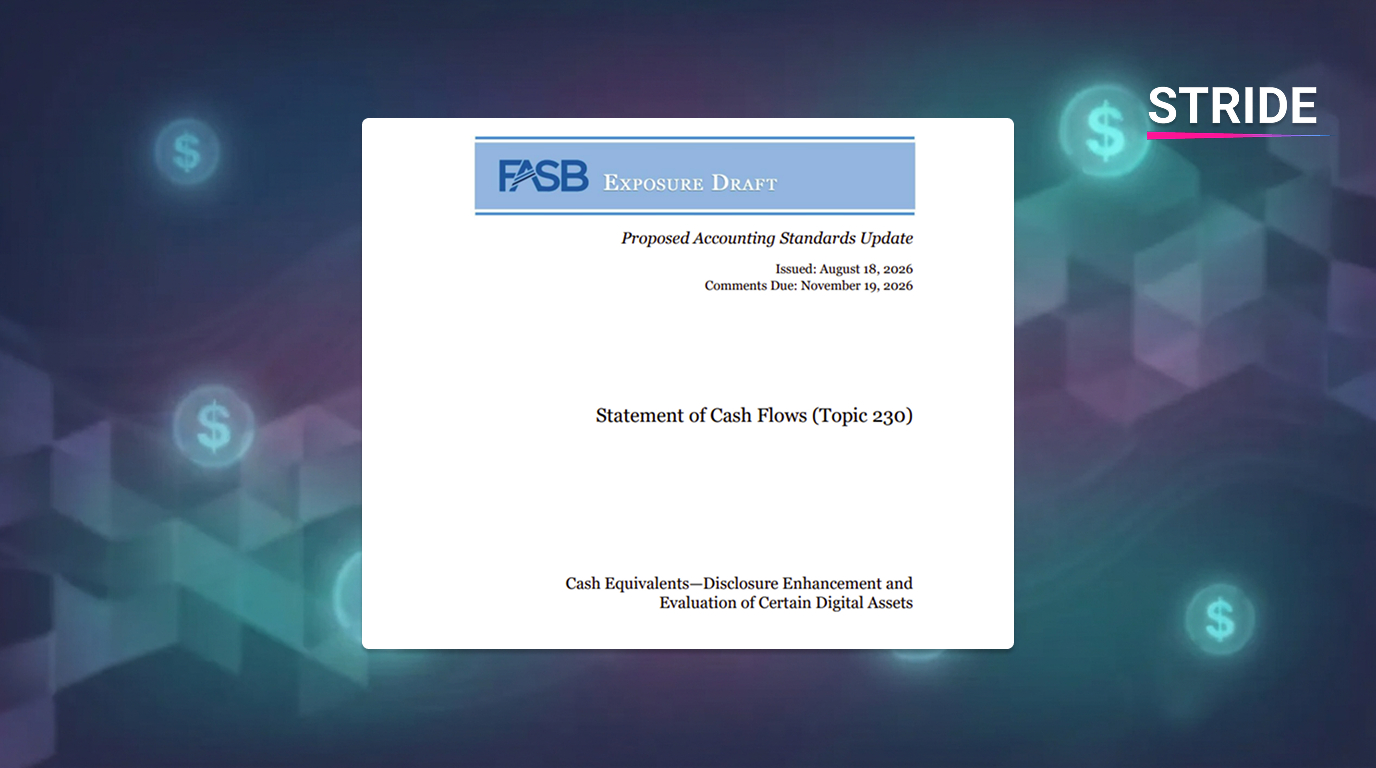
That is the operative result of the exposure draft the Financial Accounting Standards Board issued on 18 August 2026, and it is worth sitting with, because it inverts how most people have been reasoning about stablecoin classification. The question the proposal answers is not "is this token cash-like." It is "what is your relationship with the issuer." The token is the same in both cases. The accounting is not.
We've focused here on what the proposal decides and what it deliberately leaves open, rather than on the mechanics of transition and taxonomy.
Why this landed now, and why the timing matters
The proposal was approved by unanimous vote of all seven Board members and carries a comment deadline of 19 November 2026, a 90-day window. It arrived the same day the Securities and Exchange Commission unveiled a proposed "Regulation Crypto Assets" framework offering exemptions related to crypto asset investment contracts, according to CFO Dive's coverage of both filings. Two US bodies, one day, both drawing lines around the same asset class from different directions.
The practical stakes are already visible in filings. As reported by the Ohio Society of CPAs, Coinbase disclosed in its February annual filing that it had changed how it accounted for payment stablecoins, reclassifying them as cash equivalents rather than financial instruments. The retroactive change lifted its 2024 cash and cash equivalents from $8.5 billion to $9.3 billion, and it reported $11.3 billion for 2025. That is close to a billion dollars of reported liquidity moving on a classification judgment, made under guidance that did not yet exist.
That gap is the diversity in practice the Board is responding to. Stakeholder feedback from the 2025 agenda consultation indicated that some entities had concluded certain stablecoins met the cash equivalents definition and others had concluded they did not, using the same words in the Master Glossary.
FASB refused to define "stablecoin," twice, and that was the point
The most consequential decision in the document is a decision not to act.
The Board considered three routes: revise the Master Glossary definition of cash equivalents to accommodate digital assets, create a new defined term covering digital asset cash equivalents, or publish illustrative examples showing how the existing definition already applies. It chose the third. Its reasoning is that the current definition is intentionally narrow, is well understood in practice, and does not need to be reopened to answer a question about one asset class. Reopening it would risk consequences across every other asset that has been assessed under it for decades.
Then the Board did it again. It considered a stablecoin-specific disclosure, naming each significant stablecoin holding presented as a cash equivalent. It concluded that making such a requirement operable would mean defining the term "stablecoin" in US GAAP, which it had already declined to do. So the disclosure requirement it landed on applies to cash equivalents generally, and it captures stablecoins only as one possible component among Treasury bills, commercial paper and money market funds.
The result is that US GAAP will describe qualifying attributes in some detail while never naming the category those attributes belong to. That is not evasion. It is the same instinct that keeps the definition narrow: describe the economics, not the label, because the label moves faster than the standard-setting cycle.
Three attributes, and the one that decides most cases
The proposal illustrates three attributes that a digital asset designed to hold a stable value against a reference asset would need in order to meet the existing definition: an on-demand contractual cash redemption right, a direct redemption right with the issuer for a known amount of cash, and segregated reserves held by the issuer on at least a one-to-one basis in short-term, highly liquid assets. The Board is explicit that these are interrelated and should be assessed together rather than ticked off.
Three worked cases follow. In the first, the holder maintains an account with the issuer, carries a contractual right to redeem on demand at par with no significant fees or restrictions, and the issuer segregates reserves in cash and Treasury bills with original maturities of three months or less. The units qualify.
The second case changes one fact. The holder has no account with the issuer and no direct contractual redemption right, but there are active secondary markets where it expects to sell at approximately par. The units do not qualify. Not because the price is uncertain, and not because the reserves are worse, but because the conversion runs through a market rather than a contract.
The Board's reasoning here is the part worth reading closely. It acknowledges that indirect rights obtained through intermediaries may form a chain of contracts that ultimately reaches the issuer's cash. It concludes that the chain introduces counterparty credit risk that makes conversion less direct and less certain. Expected liquidity is not the test. Contractual position is.
Distribution now determines accounting treatment
Follow that logic into the market as it actually operates and the implication is sharp.
Most holders of most stablecoins do not have an account with the issuer. Direct mint and redemption rights sit with a small set of authorised participants. Everyone else acquires tokens from exchanges, wallet providers and payment platforms. Under the proposed examples, that ordinary route produces an asset that does not qualify as a cash equivalent, however deep the secondary market and however solid the reserves behind it.
So the classification question resolves into a distribution question. A corporate treasurer who wants stablecoin balances to sit in cash equivalents needs a direct contractual relationship with the issuer, not merely a position in the token. We've argued before that distribution rather than token design is what determines outcomes in this market. This proposal writes that principle into the balance sheet.
The Board also declined to define what "on demand" means, noting only that stakeholders generally understand it as redemption within normal processing time and without undue delay. Given that a redemption right which slows under stress is exactly the failure mode that matters, that phrase is likely to attract comment letters.
Overcollateralisation earns nothing
The third case addresses reserve composition. An issuer holds reserves one-to-one, segregated, but in crypto assets and gold rather than cash and short-dated government paper. The units do not qualify, because those reserves can move in value for reasons unrelated to interest rates and therefore present more than an insignificant risk of change.
The Board adds a refinement that will matter to issuers. Holding excess reserves does not disqualify an asset. But when testing whether reserves meet the one-to-one threshold, only the short-term, highly liquid portion counts. A buffer of volatile collateral stacked on top of thin liquid reserves does not close the gap. Under this test, overcollateralisation in the DeFi sense earns nothing at all.
There is a further consequence embedded in the same paragraph. To make the assessment, a holder needs enough information about the issuer's reserve amount and composition to evaluate it. Reserve transparency stops being a marketing attribute and becomes an input to the holder's own financial statements.
Jurisdiction enters through a side door
The proposal instructs entities to take relevant laws and regulations into account when setting a cash equivalents policy, citing the GENIUS Act by name and noting that other jurisdictions matter too. Some stakeholders worried this would drag legal opinions into the audit; the Board responded that considering legal implications is generally assumed and that no legal opinion is intended to be required.
Read plainly, this means the accounting answer can vary by jurisdiction even when the economics do not. A token whose treatment is settled in one market may be constrained in another, and a multinational holder inherits that variation across its reporting entities. Mapping which frameworks permit what is now an input to a cash equivalents policy, which is one reason we maintain the STRIDE Stablecoin Regulation Tracker as a free public resource across 200+ jurisdictions.
What this means for each side of the transaction
For corporate holders, qualifying is not the same as presenting. The proposal preserves the accounting policy election, so an entity that meets the criteria may still choose to present the asset outside cash equivalents. The Board also notes the cost of the alternative: an entity that uses stablecoins operationally but does not present them as cash equivalents generally has to track those transactions separately for the cash flow statement or disclose them as noncash activity.
For issuers, the three attributes read as a product specification. Direct redemption accounts, on-demand terms without significant fees or restrictions, segregated reserves in short-dated liquid assets, and enough disclosure for a holder to verify all of it. Whether an issuer offers direct accounts to ordinary corporate holders is a commercial choice with a reporting consequence attached.
For banks and other intermediaries, the second case describes exactly the position their customers occupy. A distributed token is not a cash equivalent in the holder's hands, and any arrangement that changes that answer has to reach through to a contractual claim on the issuer.
For investors and auditors, the new annual disclosure of significant components and related amounts applies to every entity presenting cash equivalents, not only those holding digital assets. It aligns loosely with IAS 7 while stopping short of requiring the components of cash or a reconciliation to the statement of financial position. Transition for the examples is modified prospective, with a reconciliation of opening balances before and after adoption, and no preferability assessment for the affected digital assets. The effective date is still open.
A definition arrives by inference
What makes this document unusual is the shape of what it produces. No new term is defined. The old definition is untouched. And yet, by the time three cases have been worked through, US GAAP contains a fairly precise description of a stablecoin that behaves like cash: fully reserved in short-dated liquid assets, segregated, and redeemable on demand at par by the holder directly from the issuer.
That description is stricter than most regulatory perimeters and considerably stricter than market usage. It arrives by inference rather than by statement, which was the design.
We've argued that every stablecoin law draws a perimeter without defining a stablecoin, and that the tokens left outside a perimeter don't disappear, they relocate. Accounting now draws one more, from the opposite side. Regulatory perimeters run through the issuer and ask what may be issued and by whom. This one runs through the holder and asks what may be counted. The residual it creates is a specific and sizeable population: tokens that are fully reserved, liquid, and used as cash every day, held by parties whose claim reaches the issuer only through an intermediary.
What counts, in the literal sense, is not whether a token is liquid, but whether the holder's claim runs to the entity that holds the reserves. Everything between those two points is counterparty risk, and under this proposal, counterparty risk is what keeps an asset out of cash equivalents.
Source: Proposed Accounting Standards Update, Statement of Cash Flows (Topic 230): Cash Equivalents, Disclosure Enhancement and Evaluation of Certain Digital Assets, Financial Accounting Standards Board, File Reference No. 2026-ED400, issued 18 August 2026, comments due 19 November 2026.
Additional data: Coinbase reclassification figures and 2025 cash and cash equivalents as reported by the Ohio Society of CPAs. Same-day SEC "Regulation Crypto Assets" proposal as reported by CFO Dive, 18 August 2026.
Methodology: We focused on the parts of the exposure draft most relevant to institutional holders and issuers, specifically the illustrative examples, the Board's reasoning on redemption rights and reserve composition, and the new disclosure requirement. Transition and taxonomy provisions are summarised only where they bear on those points.
This article is for informational purposes only and does not constitute financial, investment, accounting, or legal advice.