Tokenised Deposits Are Supposed to Beat Stablecoins. The Bank of Italy Says That Depends on One Design Choice.
The case for tokenised deposits has become something close to a consensus. Writing in the Capital Markets Law Journal this year, Ross Buckley, a member of the Reserve Bank of Australia's Payments System Board writing in a personal capacity, concluded that tokenised bank deposits are likely to win the contest against stablecoins and CBDCs in wholesale and cross-border payments. They offer the same advantages as stablecoins, he argued, plus interest, central bank support in a crisis, and none of the uncertainty over how stablecoin holders rank in an issuer's bankruptcy.
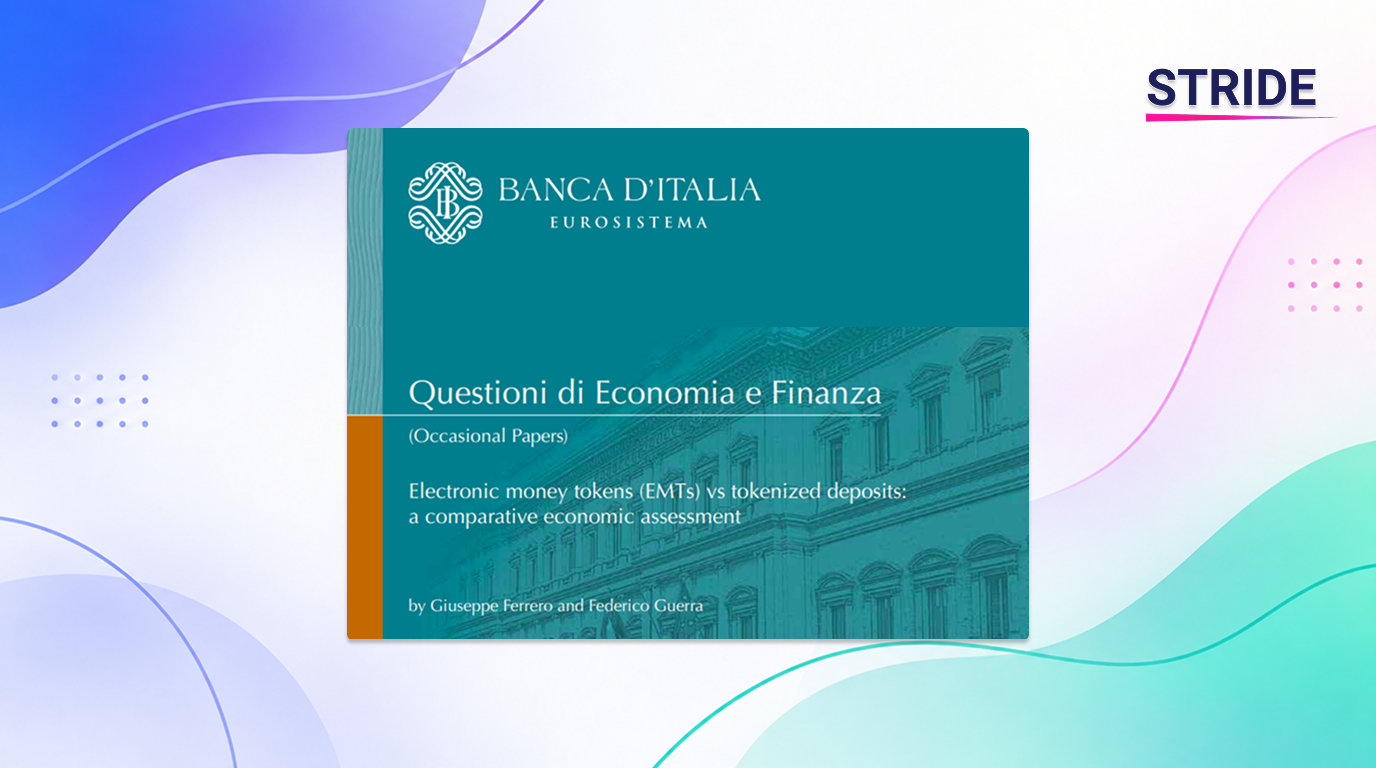
A Banca d'Italia occasional paper published this month suggests that conclusion holds for only one kind of tokenised deposit.
Giuseppe Ferrero and Federico Guerra compare euro e-money tokens (EMTs, MiCA's category for single-currency stablecoins) with tokenised deposits, and their central finding is that the label on the instrument tells you very little. What matters is whether the token is a bearer instrument, and whether it settles inside or outside central bank infrastructure. On that test, a bank-issued EMT and a bearer tokenised deposit are, in the authors' words, near-identical. And if they are economically the same, they should arguably be regulated the same: no interest, no deposit insurance, and the same liquidity treatment.
We've focused on that test and what follows from it, rather than on the paper's monetary policy section. The views in the paper are the authors' own, not the Bank of Italy's.
Why this matters now
The paper is written into an open policy process. The European Commission's targeted consultation on the review of MiCA, which closed on 30 September 2026 after an extension from 31 August, asks directly about most of the questions the paper addresses: whether EMTs should be allowed to pay interest, whether banks issuing EMTs should be required to segregate reserves, how tokenised deposits should be treated, and whether lender-of-last-resort access should extend to non-bank issuers. The Commission's review report is due by mid-2027.
The market it is written about is small. The paper notes that euro-denominated EMTs account for less than 1% of the global stablecoin market. Allium's latest data, which we covered this week, puts all non-dollar stablecoin supply at $1.3 billion out of $304.9 billion. The euro side of this market is being designed before it has scaled, which is exactly when design choices matter most.
The test: who holds the redemption right?
The paper's distinction is precise, and worth stating carefully.
A non-bearer tokenised deposit is account-based and linked to an identified customer. When it moves, the sender's token is cancelled and a new one is issued to the receiver, with settlement in central bank reserves, exactly as an ordinary bank transfer works today. It never circulates outside the banking system, so it has no secondary market and cannot trade away from par.
A bearer tokenised deposit can circulate to holders outside the issuing bank without the bank's balance sheet changing at each transfer. The balance sheet adjusts only when someone redeems. The right to redeem belongs to whoever holds the token at the time, not to whoever originally bought it.
EMTs are bearer instruments in the same sense. So, in the authors' framing, the meaningful line does not run between stablecoins and tokenised deposits. It runs between bearer instruments, of either kind, and non-bearer ones. We drew a different line when we looked at where the money actually sleeps in stablecoins and tokenised deposits, focusing on legal structure and economic impact. This paper adds a dimension that cuts across both labels.
If they are the same, rule them the same
Having established that a bank-issued EMT and a bearer tokenised deposit are economically equivalent, the paper applies the "same activity, same risk, same regulation" principle to three areas.
Interest. MiCA prohibits remuneration of EMTs, by issuers and by crypto-asset service providers alike, and the prohibition is deliberately broad: any benefit linked to how long the token is held, including discounts and third-party rewards, counts as interest. The authors argue the ban should extend to bearer tokenised deposits. Otherwise banks would have an incentive to structure bearer payment instruments as deposits purely to escape it. Non-bearer tokenised deposits, being ordinary deposits, can keep paying interest.
Deposit insurance. EMTs are excluded from deposit guarantee schemes, which protect retail deposits up to €100,000. The paper argues bearer tokenised deposits should be excluded too, both because identifying holders in decentralised settings is technically difficult and because covering one but not the other would create an asymmetry with no basis in risk. Non-bearer tokenised deposits keep coverage.
Liquidity rules. Here the deciding factor is not the instrument's legal label but whether the bank can identify the holder continuously, the test set out in the Basel framework. Where it cannot, which the paper describes as the structural condition of bearer tokens circulating on permissionless blockchains through unhosted wallets, the liability must be treated as unsecured wholesale funding: a 100% run-off rate in the liquidity coverage ratio and no stable funding credit for maturities under six months. That makes these liabilities far more expensive to hold than retail deposits, with knock-on effects on credit supply.
This is where the paper bears directly on the consensus. If bearer tokenised deposits lose the right to pay interest and lose deposit insurance, two of the three advantages the "tokenised deposits will win" argument relies on apply only to the non-bearer kind. The central bank backstop, as the next sections show, does survive, because it depends on who issues the token rather than what form it takes.
The authors are honest that one part of their own framework deserves scrutiny. Treating bearer instruments as less stable than deposits assumes transferability increases outflow risk. But when a bearer token changes hands, the issuer's obligation does not leave its balance sheet; only redemption does that. The real risk driver, they suggest, is redemption frictions, not transferability as such.
The gap nobody regulates
That argument leads to the paper's most practical finding. Bearer tokenised deposits issued by banks currently fall under no instrument-specific framework at all. MiCA excludes them because they qualify as deposits. Bank prudential rules do not address their characteristics as transferable instruments with a potential market price. The European Banking Authority has acknowledged the classification question as open.
The result is that two instruments with very similar economic properties, a bank-issued EMT and a bank-issued bearer tokenised deposit, could face radically different regulatory treatment. The paper describes this asymmetry as not grounded in any difference in risk and difficult to reconcile with "same activity, same risk, same regulation". Its working assumption, that bearer tokenised deposits should be treated as EMTs, is effectively a proposal for how to close the gap.
Par is an equilibrium, not a property
The paper's treatment of secondary-market pricing is its most memorable section, and it does not depend on any regulatory proposal.
Even with good reserves and a legal promise of redemption at par, a bearer token can trade below par whenever redemption takes time. The longer and less certain the wait, the more the token behaves like a short-dated claim with a risk premium attached. The paper's historical parallel is the US free banking era, from 1837 to 1863, when privately issued banknotes circulated at discounts that varied with the issuing bank's distance and creditworthiness, reaching up to 20% for distant banks. Newspapers published the prices, and note brokers made markets in them. The settlement lag, the authors argue, now plays the role distance played then.
The lags are not trivial. MiCA guarantees redemption at par at any time but leaves the timeline to each issuer's white paper. The paper's survey of the main euro EMTs finds implied settlement lags ranging from minutes for verified participants to around five days for several issuers, and in one case, Société Générale-Forge's EURCV, from about ten to thirty days.
Shortening the lag is not a free fix. Faster redemption strengthens the peg but leaves the issuer less time to raise cash after a shock, so it increases run risk. The authors call this trade-off structural and say it cannot be eliminated. Par convertibility, in their formulation, is not a mechanical property of the instrument but an equilibrium that depends on reserve quality, market expectations and redemption timelines together.
The issuer matters more than the token
One distinction cuts across the bearer test. A bank issuing bearer instruments can draw on central bank liquidity, intraday credit and, ultimately, the lender of last resort. An e-money institution cannot. It has to meet redemptions from its reserves, sold at market prices under stress. The paper describes the de-pegging risk of EMI-issued EMTs as categorically more severe than that of bank-issued bearer instruments for exactly this reason.
It also identifies a perverse side effect of MiCA's design. EMIs must hold at least 30% of reserves as bank deposits, rising to 60% for significant issuers, partly to keep stablecoin money inside the banking system. But under Basel rules those deposits carry a 100% outflow rate for the receiving bank, which must then hold an equivalent amount of high-quality liquid assets. A rule meant to support bank funding ends up raising banks' liquidity costs. The paper contrasts this with the Bank of England's proposed regime for systemic sterling stablecoins, under which issuers would hold 40% of backing assets directly at the central bank, avoiding the externality at source.
Could a bank back its EMT with central bank reserves?
The paper asks whether a bank could issue an EMT fully backed by central bank reserves, and the answer is a careful no in practice. Nothing in MiCA forbids holding one euro of reserves per euro of EMTs. But a bank's liquidity rules apply to its balance sheet as a whole, and banks cannot maintain segregated central bank reserve accounts dedicated to specific liabilities. Even matched reserves would not be a legally meaningful earmark, and the authors see little economic incentive to try.
That is a useful contrast with the BIS prototype we covered last week. In Project Aurum's first phase, a bank-issued, CBDC-backed stablecoin modelled on Hong Kong's note-issuing banks locked central bank money in a smart-contract custodian account for each token issued. That kind of one-to-one earmark is something a purpose-built system can do and a bank operating under MiCA's balance-sheet model, on the paper's analysis, cannot.
What follows for each group
Banks. The choice between bearer and non-bearer design is not a technical detail. Non-bearer tokenised deposits keep interest, deposit insurance and standard liquidity treatment, and the paper sees them as a genuine efficiency gain with a contained risk profile. Bearer designs, whether called EMTs or tokenised deposits, are likely to carry heavier liquidity requirements and, on the paper's reasoning, should lose the deposit-like advantages.
E-money institutions and stablecoin issuers. The absence of central bank access is the first-order structural difference between EMI and bank issuance. The MiCA consultation asked whether emergency liquidity support should extend to EMIs; the paper treats that as the question that determines how severe de-pegging risk can become.
Treasurers and holders. The redemption timeline in a white paper is, in effect, part of the price. Two euro EMTs that both promise redemption at par can carry very different effective maturities.
Regulators. The paper's main policy point is that outcomes depend on the framework at least as much as on the instrument, and that bearer tokenised deposits currently sit outside any framework designed for them. Tracking how jurisdictions classify tokenised deposits relative to stablecoins is part of why we maintain the free Stablecoin Regulation Tracker across 200+ markets.
The framework is the instrument
The paper's closing argument is its strongest: the monetary and financial stability properties of these instruments are not intrinsic to the tokens. They are created by regulatory choices about reserves, redemption, remuneration, transferability, settlement and access to backstops. The same token, the authors write, can behave as a stable payment instrument inside the two-tier system or as a bearer claim whose market price becomes a channel of fragility.
That is why the contest between stablecoins and tokenised deposits may be the wrong frame. The more useful question is which design a bank chooses, and whether regulation treats the same design the same way regardless of its name. If the paper's reasoning prevails, the tokenised deposit that wins will be the non-bearer one: account-based, settled in central bank money, and in most respects an ordinary bank deposit recorded on a new ledger. The bearer version will be a stablecoin by another name, and regulated like one.
Source: Electronic money tokens (EMTs) vs tokenized deposits: a comparative economic assessment, Giuseppe Ferrero and Federico Guerra, Banca d'Italia, Questioni di Economia e Finanza (Occasional Papers) No. 1062, October 2026. The views expressed are those of the authors and do not involve the responsibility of Banca d'Italia.
Additional sources: Ross P. Buckley, "The contest between central bank digital currencies, stablecoins, and tokenized deposits: Which will likely win, and why?", Capital Markets Law Journal, 2026, 21(2); the author writes in a personal capacity and his views are not those of the Reserve Bank of Australia or its Payments System Board. MiCA review consultation deadline extension to 30 September 2026, announced 29 June 2026, as reported by Regulation Tomorrow. Non-dollar stablecoin supply from Allium's State of Stablecoins and Payments, Q3 2026.
Methodology: We focused on the paper's bearer and non-bearer distinction, its equivalence argument and the regulatory gap it identifies, together with its analysis of secondary-market pricing and issuer type; its monetary policy transmission section is not covered in detail. The application of the paper's findings to the case for tokenised deposits made by Buckley is our own.
This article is for informational purposes only and does not constitute financial, investment, or legal advice.